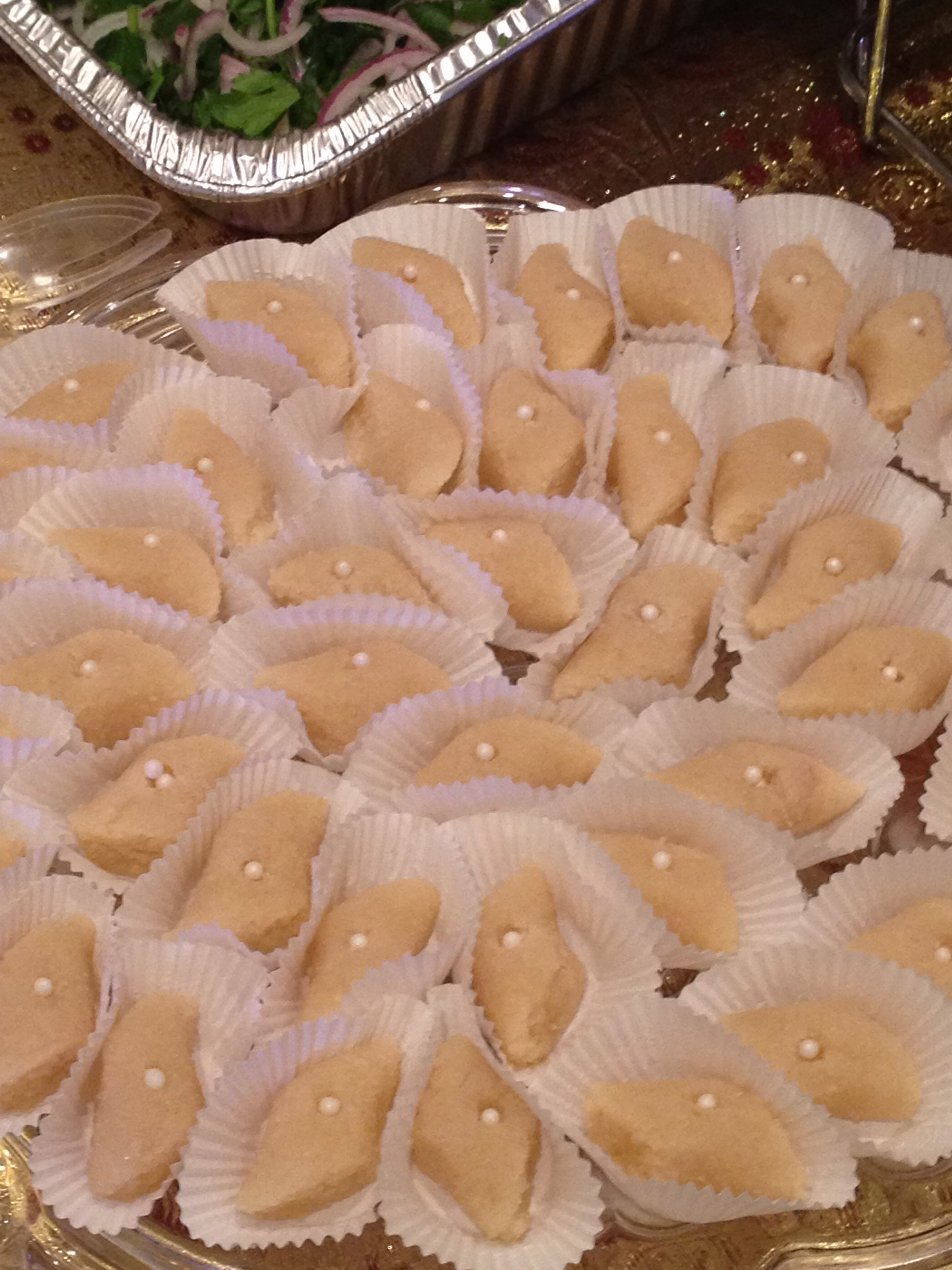
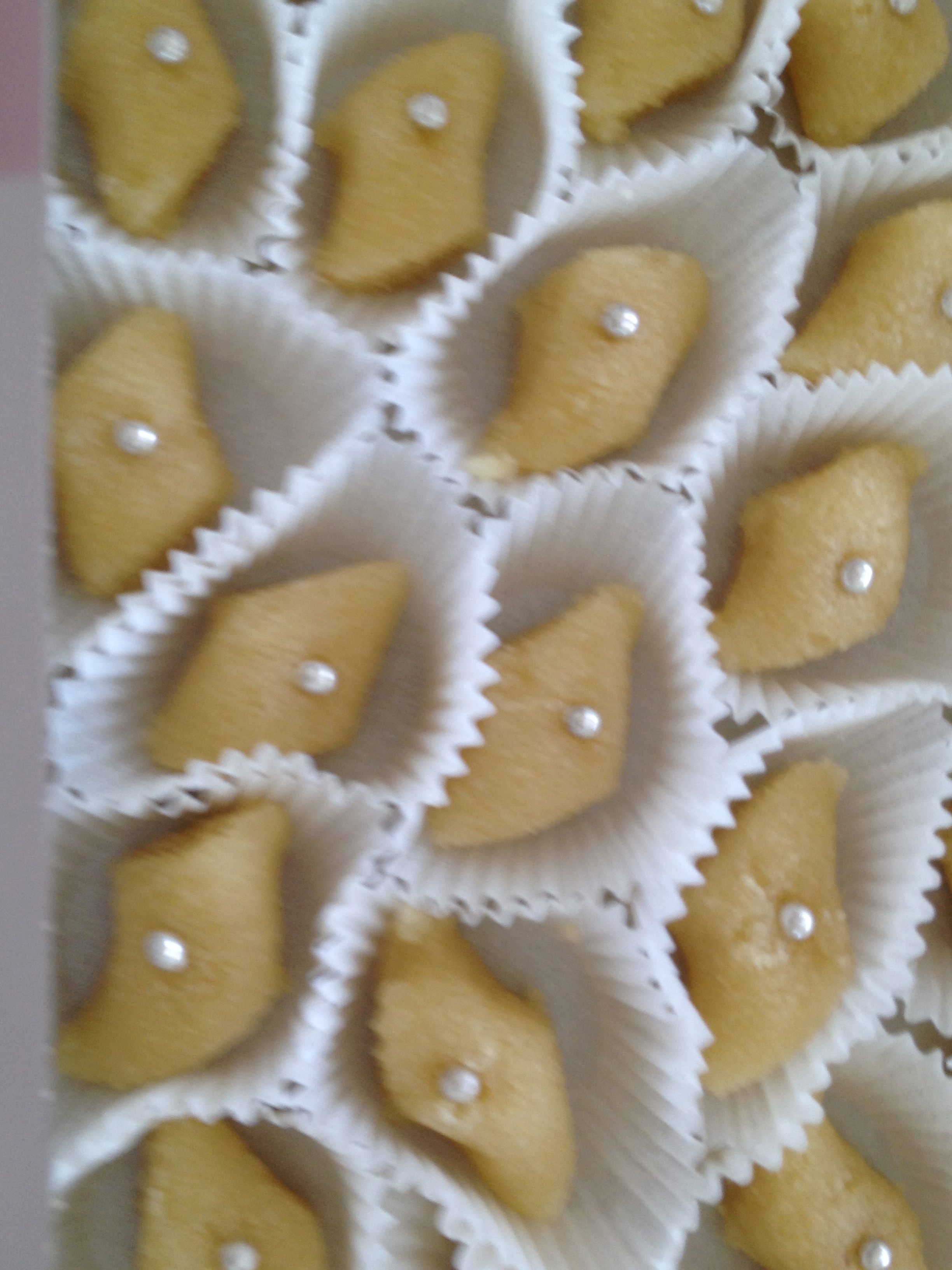
Seems like yesterday that my mom made masapan (Marzipan) for my son and his fiancé when they got engaged, a family tradition. “If my mother or my sisters were here, they would make it with me. As long as I’m able, I’ll make it, so we can carry on the tradition. You girls learn to make it for the next generation.” And so we have.
As we’ve shared on our blog before, ‘masapan’……marzipan….is that delicious sweet that our mothers lovingly make for engagements, weddings, a brit mila or a Bar (and today even a Bat) Mitzvah. Basically a homemade almond confection made with ground almonds and sugar, marzipan traces it’s origin to …..well….that depends. Some say the Persian empire, introduced to Europe by the Turks; others claim the origin to be Spain. In any case, it got to us, was a delicacy on our beloved Island of Rhodes, and our grandmothers brought it here with them when they came to these shores.
While some from Eastern Europe talk of marzipan being colored and fashioned into miniature, fruit-like shapes, our variation is kept in its white, pure state, made into a simple design.
Originally made by blanching raw almonds, grinding them and mixing with a homemade, stovetop cooked simple syrup, lately we have been using a more simple recipe made more accessible using almond flour and powdered sugar. The texture is perfect and the taste, delightful. I made a small batch this morning as a trial and I’m pleased with the results. Give it a try and let me know your thoughts.
This is the recipe my mom wrote down for my cousin in Portland. I’m not sure who originated this combination…. Please let me know if you do. I’d like to acknowledge them.
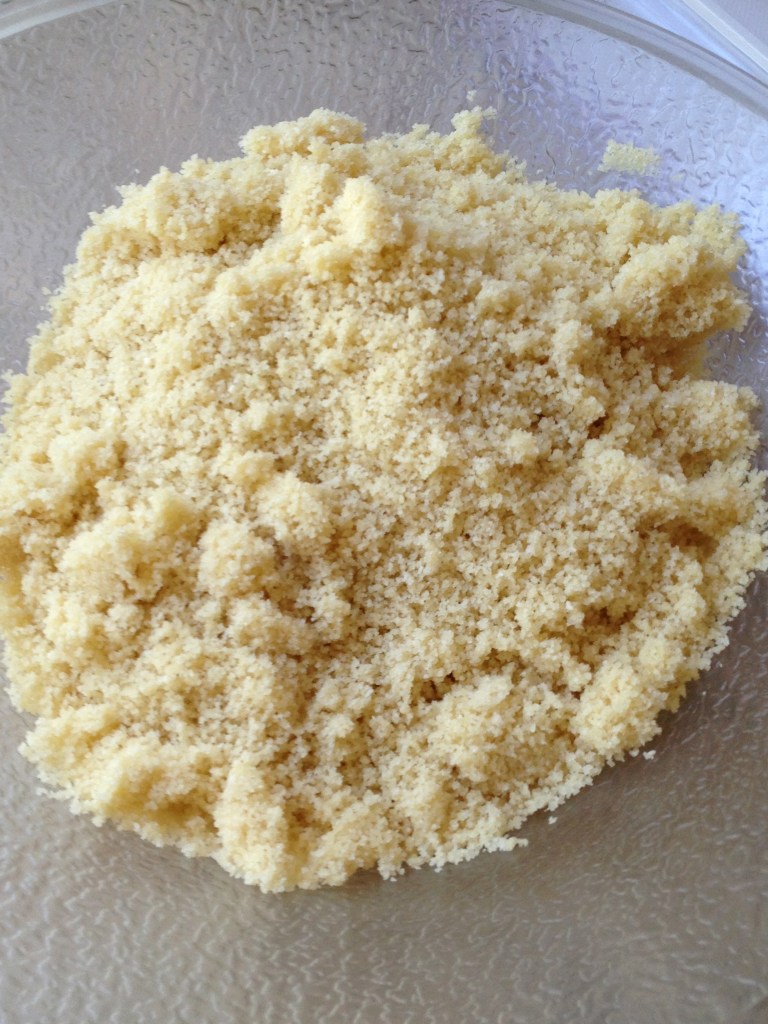
Using 2 cups of Almond Flour (I use Kirkland brand from Costco), 1 1/4 cup powdered sugar and 1/4 cup of water. Mix it all in a food processor. It will all come together into a ball with a soft dough consistency.
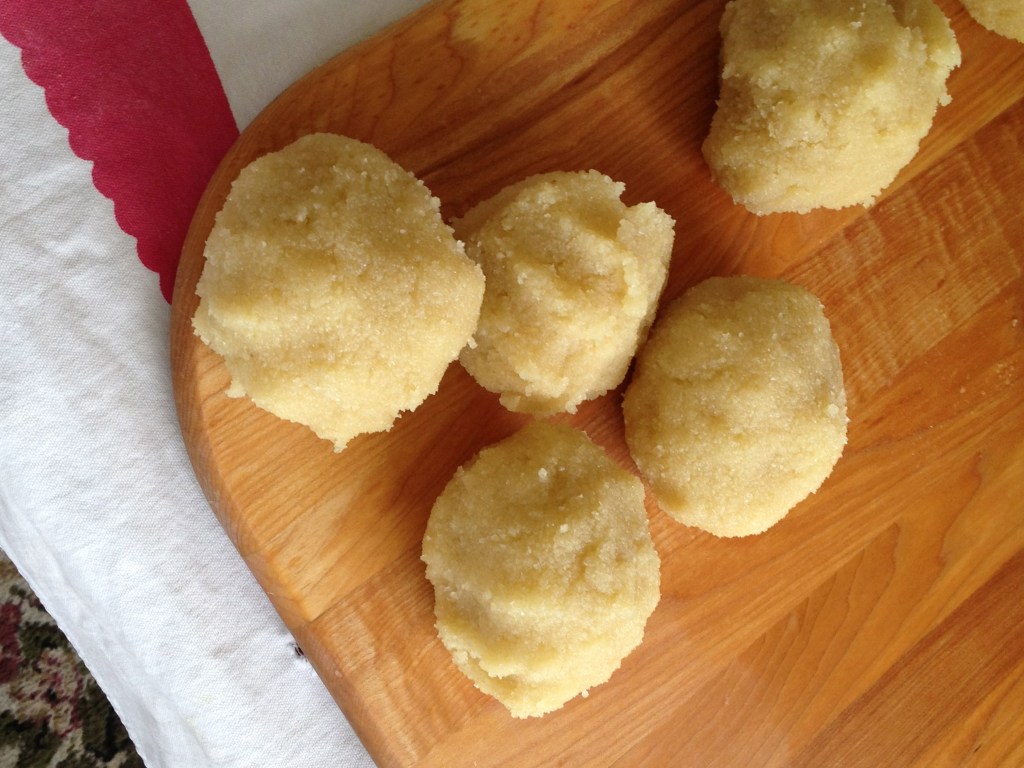
I rolled it into three smooth balls, then rolled out into a rope about 3/4” thick. Then cut at an angel to create diamond shaped pieces.
Our tradition has been to top with a decorative silver ball ( dragees ). These are for decoration and not to be consumed. (although there are decorative small balls of various colors that are edible and equally lovely)
L’dor v’dor. Keeping our culinary traditions alive for the next generation.
Bendichas manos. May your hands always be blessed. 🧿💞🥰
Tomorrow night marks the beginning of the Jewish New Year.
I love new beginnings.
A time to start anew.
To look to the year ahead and envision and create who we will be, how we will build on and improve the way we are, how we interact, how we listen, support and love.
How we can make our world, our town, our community and our family better.
How we can love …. Bottom line, it is what really matters.
Open our hearts, our souls….listen to one another. HEAR each other. That’s the basis of love.
To serve, to be there for each other. Making the world a better place.
Passing the mirror and noticing the frame.
Looking beyond.
May the year ahead bring each of us good health, healing of body, heart and soul. May we be blessed to grow in our connection to HaShem.
May we be blessed to grow in our true connections with each other.
May it be a year of success, of family blessings, moments of meaning and moments of making a difference.
May we find the calm within to help build the calm in our world.
May we nurture the love within to help bring more love to the world.
May we take the time, make the time, to notice the daily miracles in life, and may we find the time to show and give gratitude to Hashem, who makes it all possible.
May we be better today than we were yesterday. And may we open our hearts and minds to be even more tomorrow.
May we realize that we all have so much more in common and so much more love to share than we once thought possible.
Tizku LeShanim Rabot Tovot V’ne’imot.
May we each merit many good and pleasant years. Tizku ve tehiye ve taarikh yamim. May we merit and live and may our days be lengthened.
Amen
~Marcia
Precious Pastelikos
There are only a few ladies left in Los Angeles that know how to make these treats that date back to medieval times. I decided the time had arrived for me to master the pasteliko!
Rhodes is a tiny island in the middle of the Aegean Sea. Captured from Greece by the Ottoman Turks, it provided a safe haven for the Jews of Spain. They escaped the Inquisition with their faith and traditions, their Ladino language (Judeo-Spanish) and their beloved recipes. In the early years of the 20th century, many young Rodeslis left in search of opportunity. They established communities in Seattle, Atlanta, New York and Los Angeles.
When I met my husband Neil in the early 1990’s, I was introduced to some pillars of the Los Angeles Rodesli community. They welcomed me into their hearts and homes, and especially into their delicious kitchens.
Over the years, my mother-in-law taught me how to bake many of their unique delicacies, including burekas, boyos, biscochos, reshas, rojaldes and frijaldados. But there was one little gem of the baking repertoire that I never felt confident enough to learn — pasteliko (little pies). They are a small round savory pastry filled with ground meat or eggplant. Quite time intensive to make, but so worth the effort. Becky, my mother-in-law, used to lovingly craft them for us, but then her hands became arthritic and she was no longer able.
Recently, Neil was reminiscing about this favorite treat. He told me that before his mother learned to bake them, the old ladies of the community loved to spoil him with a steady supply. There are only a few ladies left in Los Angeles that know how to make these treats that date back to medieval times. I decided the time had arrived for me to master the pasteliko!
I emailed our dear friend Marcia Israel Weingarten and asked her if she thought her lovely mother Kaye would consider teaching me. Marcia writes the amazing food blog, “Bendichas Manos” (Ladino for “blessed hands”). She runs a popular Facebook group by the same name filled with her mother’s recipes and videos keeping the old memories alive. I was so honored when Marcia invited me over one morning to learn how to make these savory treats with her mother Kaye Israel.
Kaye Israel and Marcia Israel Weingarten Photo courtesy Marcia Israel Weingarten
Kaye’s parents, Hacco and Sarota Hasson, were born, raised and married on the Island of Rhodes, when it was still part of the Ottoman Empire. In 1909, they arrived in Seattle, Washington, a magnet for the Ladino-speaking Jews of Rhodes and Turkey. Kaye was born there, the youngest of five children. They lived in the Yesler Way neighborhood, surrounded by many other families from Rhodes. Her father was a shoeshine man who worked in the Pioneer Square District in Downtown Seattle. He built them a home and eventually bought the property next door where he built a second home, all on a shoe shining income! They lived up the hill from the Rodesli synagogue and on Saturday mornings, friends would pass by after Shabbat services. Her mother would always invite them in for “Desayuno” (traditional cheese-and-spinach filled breakfast pastries, fritatas, cheeses, brown hard-boiled eggs and more).
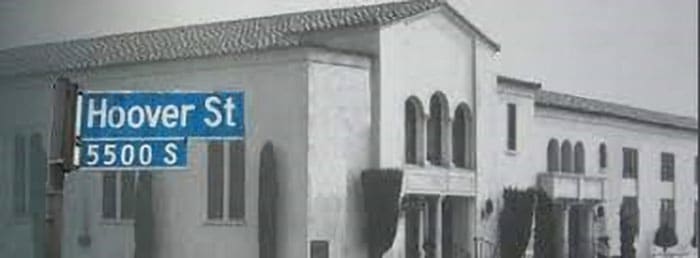
In 1929, when Kaye was only five, her eldest sister was engaged to a man from Los Angeles. The family decided they should all move together and they settled on 52nd Street and Hoover, near the Coliseum. This was the center of Rodesli Sephardic life in Los Angeles and cousins, second cousins, in-laws, aunts and uncles all lived close together.
On Shabbat afternoons they would go to Kaye’s aunt tia Rosha Solam for a vijita (visit). The ladies would sit and drink caveh (coffee) and snack on pipitas (roasted pumpkin seeds), sweets and fresh fruits. Homemade dulse (sweet preserves) were passed around and the spoonful of sweetness would be washed down with a glass of water. In the late afternoon, the table would be set with either pastellikos or boyos and burekas.
This tradition carried into the 1960’s, when the community lived in Liemert Park and Crenshaw Village. As a child Neil remembers tagging along with his grandparents to the home of La Ermana Miriam, the mother of his “aunt” Sylvia. Almost every home on that block of Dublin Avenue belonged to a Sephardic Rodesli or Turkish family. The first building of the Sephardic Hebrew Center was located nearby at 55th and Hoover. The Sephardic Temple Tifereth Israel (now on Wilshire Boulevard in Westwood) was just around the corner on Santa Barbara Avenue (now MLK Boulevard).
Photo courtesy of Aron Hasson
Kaye recalls that growing up, especially during the Great Depression, meat was not a staple. On Friday nights, they would eat chicken in honor of Shabbat. Weeknight dinners consisted of vegetables sometimes cooked with a small piece of lamb, just to add flavor. Beans were flavored with marrow bones and there was always Sephardic red rice, cooked with tomato sauce. Food was never wasted. When her mother peeled zucchini for a dish, the peels were saved and chopped up with garlic, lemon and oil and served as a tapenade.
While Kaye learned to cook primarily from her mother, when her mother passed away, Kaye would spend many days baking with her aunt Boule Benveniste. Boule taught her that “first you taste with your eyes” and that it was paramount to create uniform and eye pleasing items when baking. She would spend hours in the kitchen, listening to her aunt tell stories about life in Rhodes. That is how the family stories have been passed on, sharing tales one generation to the next.
Soon after receiving the invitation from Marcia, I took a day off work and headed out to Tarzana. Along my drive, I reminisced about her father and Kaye’s husband Jack Israel, who had a wonderful sense of humor and a special “down to earth” kindness. He was president of the Sephardic Hebrew Center (where Neil became the youngest board member). Jack was a very smart, talented and eloquent writer who became the first editor of the SEC’s Hamerkaz Newsletter. He was LA’s first “Sephardic blogger,” only he used pen and paper! He was so good to all us young adults in the early days of the Sephardic Educational Center.
As soon as I walked in to Kaye’s home, I felt so welcome. The dough was already prepared. “I know that you know how to make this dough. It is the same as the bureka dough your mother-in-law Becky makes,” Kaye told me. So we immediately started with the conduchu, a meat filling which consists of ground beef, onions, parsley (some cooks add cut up brown hard boiled eggs). We went to the dining room table, where there were three boards and trays of dough. Kaye and Marcia had already formed the dough into apricot size balls (for the cups) and smaller walnut size balls (for the hats).
Kaye patiently showed me over and over how to shape the dough. “Okay, go ahead,” she said. I didn’t expect to be thrown in the deep end so quickly! I usually pick up cooking skills pretty quickly, but this was truly challenging. Kaye was very patient and kind, as she tried to guide my hands in this unfamiliar task. Marcia, who has been in the kitchen with her mother all her life, gave me a few tips.
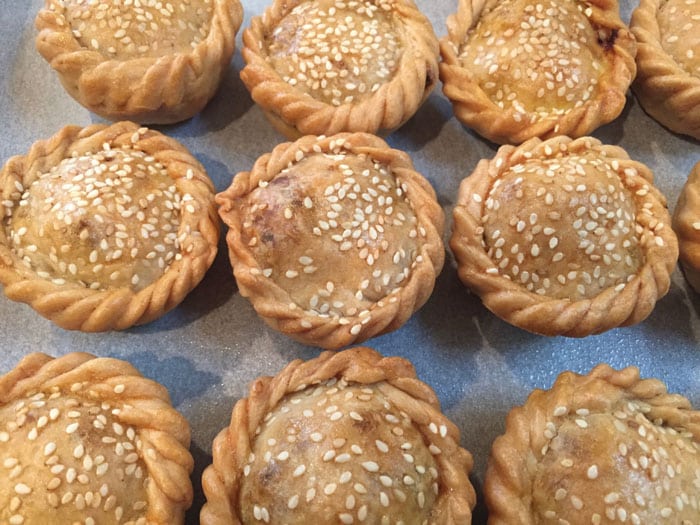
I kind of got the hang of forming the little cups, filling them with the meat, then taking the smaller dough pieces, dipping them into the sesame seeds and then closing up the cups. But then came the excruciatingly tough part—crimping the edges of the “hat”. There’s a video of Kaye on Facebook showing how to crimp the dough. I’ve probably watched it one hundred times. I have never been able to get it right. We finished up all the meat filling and we put all the pastelikos into the hot oven.
We shared a lovely lunch featuring these delicious freshly baked meat pies. I heard Kaye’s amazing stories about growing up in Los Angeles’ Sephardic community.
We shared a lovely lunch featuring these delicious freshly baked meat pies. I heard Kaye’s amazing stories about growing up in Los Angeles’ Sephardic community.
Before I left, Kaye filled up a shopping bag full of pastelikos for Neil (fondly called Pasha by Marcia). She gave me another bag filled with her famous, incredibly perfect biskochos (crown shaped cinnamon cookies). She gave me all the leftover dough balls in a Tupperware and told me to use it to practice my crimping. And that night that’s what I did. To my shock and surprise, I was actually able to crimp. And it was a rather decent pretty crimp!
Neil came home from work and must have eaten at least five pastelikos while standing in the kitchen. All he could say with every bite, was “mmmmmm!”
-Rachel
Photo by Marcia Israel Weingarten
Kaye Israel’s Pastelikos Recipe
2 onions, peeled and diced 2 lb ground beef 5 tsp tomato sauce a dash of cayenne pepper (or pepper flakes) and garlic powder Salt & Pepper to taste 1/4 cup rice 1 egg 1/2 cup chopped parsley ¼ cup water
1. Parboil rice. To do so, bring 3/4 cup water to a boil. Add 1/4 cup rinsed rice. Cook covered on stove approximately 10 minutes on low/simmer heat. Rice should be only partially cooked. 2. In a large skillet (or electric frying pan) sauté diced onions, using 3 -4 tablespoons of oil. 3. Add ground beef and brown. 4. Add tomato sauce and spices, Add parboiled rice, followed by chopped parsley. Add water to mixture. Cover and cook on medium heat until all water is absorbed, approximately 35-40 minutes. Add egg to mixture to bind. While cooking, begin making dough.
Dough (for pastelikos and burekas) 3 cup ice water 2 1/2 cup oil 1 tsp salt 10 – 12 cups flour 1 cup sesame seeds 1. Put ice in measuring cup and ice water to 3 cups 2. Add oil and salt. 3. Incorporate flour into dough as you add it. (Ice cubes will melt and/or will “pop up” and you will remove as dough is mixed.) 4. Once dough is ready, prepare balls the size of an apricot for the “cup”, and a ball the size of a walnut for the “hat.” 5. Place an apricot-sized ball in the palm of your hand. Use the thumb on your other to form the cup. Fill with conduchu. Then, take a walnut sized ball, dip it in a bowl of sesame seeds, then flatten. Place on top of the filled “cup” (sesame seed side facing out). 6. Crimp close the edges. Place in a mini cupcake tin. (helps pastelikos keep their shape). 7. Brush with an egg wash (beat an egg with a few drops of water). 8. Place on lower shelf in 350°F oven. 9. Bake until bottoms begins to turn color (golden), about 20-25 minutes. (This will depend on your particular oven. Keep an eye on them.) 10. Move to top shelf until tops are a gold color. Pastelikos are delicious right out of the oven! (after a few minutes of cooling). They freeze well. Pack in airtight freezer bags or boxes. To enjoy from the freezer, defrost and reheat at 350 degrees in the oven.
Sharon Gomperts and Rachel Emquies Sheff have been friends since high school. The Sephardic Spice Girls project has grown from their collaboration on events for the Sephardic Educational Center in Jerusalem. Follow them on Instagram @sephardicspicegirls and on Facebook at Sephardic Spice SEC Food. Website sephardicspicegirls.com/full-recipes.
A SEPHARDIC ROSH HASHANAH CEREMONY COMBINES ELEMENTS OF TASHLICH AND A HEALING RITUAL.
From Marcia Weingarten
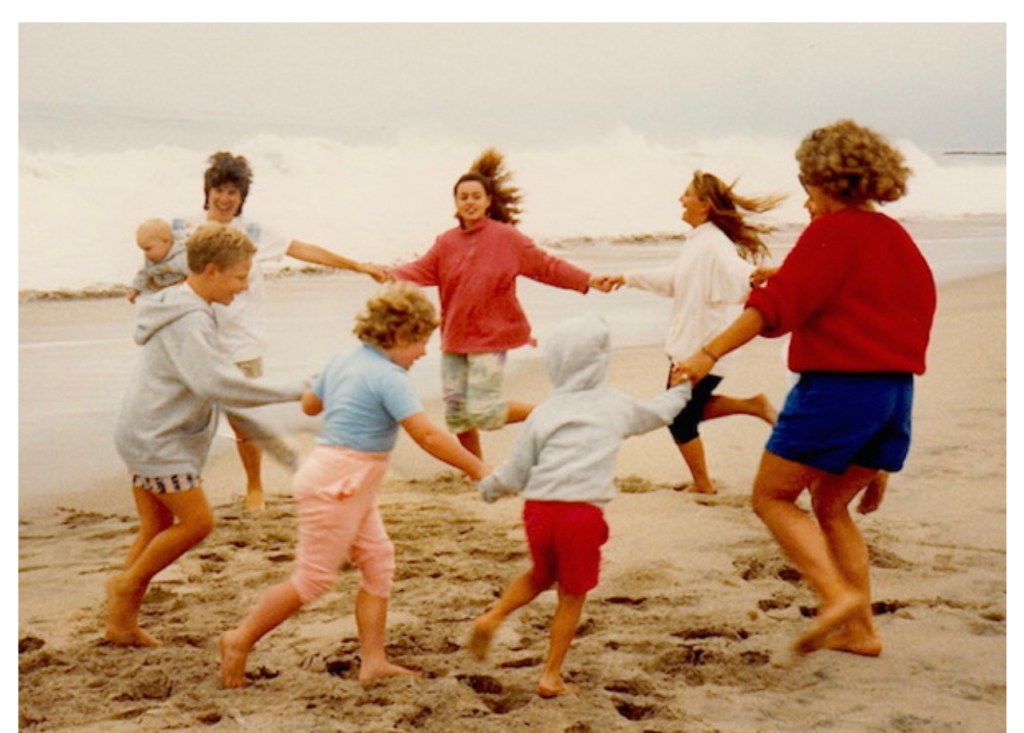
Next Sunday our family will gather at Venice Beach for our yearly ‘Lavar La Cara,’ (literally ‘wash the face) at the ocean. Our tradition combines elements of ‘Tashlich’ from the Hebrew “to cast off,” referring to the custom of tossing bits of bread in the water to symbolize the casting off of our sins. The second element is a healing ritual of the Rhodeslis — those who trace roots to the island of Rhodes, tossing ailments, fears, concerns into the ocean and receiving renewed health and blessings from HaShem along with the blessings and love from our elders.
Over the generations, our family tradition had been to go to the beach on the first day of Rosh Hashanah. Now that we live in disparate parts of Los Angeles, have differing synagogue schedules and levels of observance, our extended families (about 40+ of us, spanning five generations – Mashala) come from throughout the greater Los Angeles area and meet at Venice Beach on the Sunday morning between Rosh Hashanah and Yom Kippur, bringing our beach chairs and enjoying some time together after our ritual by the shore. It truly has become one of the most treasured traditions of all generations.
Once we set ourselves up, we go down to the water, usually in smaller family groups. A family matriarch, one by one, blesses us and washes our faces. Bending down to capture a handful of water from a new wave, she washes the face of each of us, saying in Ladino, “todo mal ki se vaiga” (“everything bad should go”). She elaborates: “Everything that is bothering you, worrying you, anything that is harming you, any sickness, illness, any fright or discomfort, all this, should be swept away to the very depths of the ocean.” She then bends down to scoop a fresh handful of water from a new wave. Washing our face and the back of our neck again, this time saying “todo bien ki se venga” (“everything good should come”). Again, she elaborates, “Everything now will be good, your pain will go away, any illness will leave your body, healing will come to you. Every worry is now gone. New ideas and good thoughts will fill your mind. Your heart will be content.”
To each, now, she gives a specialized blessings for the New Year. To children she might offer that they will do well in school, be happy, have good friends, make their parents proud or have a good year in sports, theater, Hebrew school; whatever is appropriate to that child. To the young adults, she might offer that they find a good jobs or career and that they find the right person to share their lives with. Newlyweds are blessed to be happy, build a Jewish home and life together, have children, build a life of meaning and keep our traditions. After the individual blessings, the matriarch gives each of us a finger full of sugar, which she puts in our mouths for a “sweet” year. (Traditionally the sugar is from the Rosh Hashanah table. After we use sugar for our Hamotzi prayer on this holiday, the remaining sugar goes into a baggie and comes with us to the beach.)
There are variations. Sometimes we invoke the names of the Patriarchs, “Con el hombre del Dio di Avram, Izhak, Yaacov, Rey David i Shelomo,” as well as the Matriarchs, “Rivka, Sarah, Rachel, i Leah.”
On occasion we add a new tradition, like dancing along the shore. New traditions are always welcome!
Blessings complete, we return to our beach chairs, sit for a nice ‘vijita’ (visit) and enjoy coffee, juice, bagels, borekas (Sephardic cheese and rice or potato pastries), biscochos (tea cookies), spinach quashado (soufflé), assorted cheeses with olive oil (usually feta and ricotta), homemade breads (rosca), fruits and dessert pastries. We stay and visit, feeling renewed, and certainly feeling a great deal of love from and for our family. It’s a New Year. The Day of Atonement is coming soon. We are ready to face it with a humble heart, renewed spirit and a refreshed outlook.
“Masapan”……marzipan….that delicious sweet that our mothers lovingly make for engagements, weddings, a brit milan or a Bar (and today even a Bat) Mitzvah. Basically a homemade almond confection made with ground almonds and sugar, Marzipan traces it’s origin to …..well….that depends. Some say the Persian empire, introduced to Europe by the Turks; others claim the origin to be Spain. In any case, it got to us, was a delicacy on our beloved Island of Rhodes, and our grandmothers brought it here with them when they came to these shores.
While some in Eastern Europe talk of marzipan being colored and fashioned into miniature fruit-like shapes, our variation is kept in it’s white, pure state, made into a simple design – A very special variety is shaped into a ‘pastelico’ like cup and filled with rosewater or orange blossom scented ‘shroupe’, capped and artfully edged….a treat for the senses!
My mother, Kaye Hasson Israel, uses a recipe shared with her by Rebecca Levy. I’ve watched her make it. It’s a lovely addition to a Pesah sweet table.
Here is the recipe and photos. This recipe makes about 125 pieces of masapan.
6 C almonds
3 C sugar
4 C water
Start with raw almonds. To blanche, bring a pot of water to a boil. ( enough water to cover the almonds). When water boils, add almonds and leave them in for 4 to 5 minutes (until skin is loose).
Rinse in a colander with cold water. Remove the skins from the almonds and place almonds into a bowl of cold water ( to prevent discoloration).
Take a clean towel and dry almonds thoroughly.
Put almonds into food processor with blade.
Grind to a fine texture.
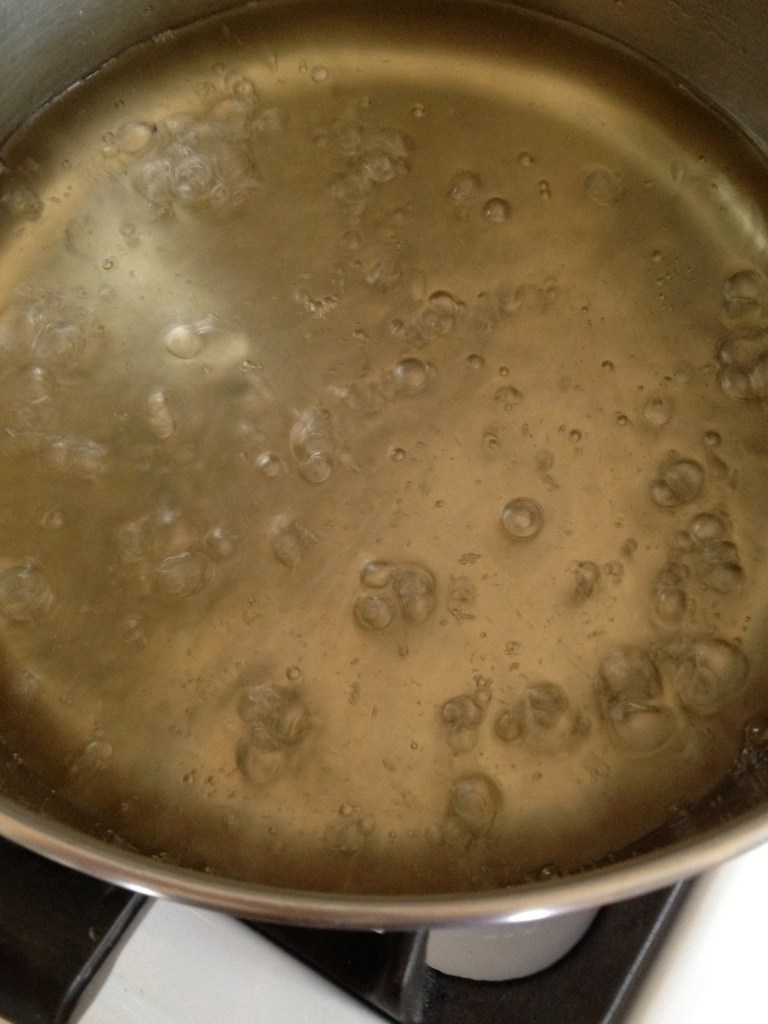
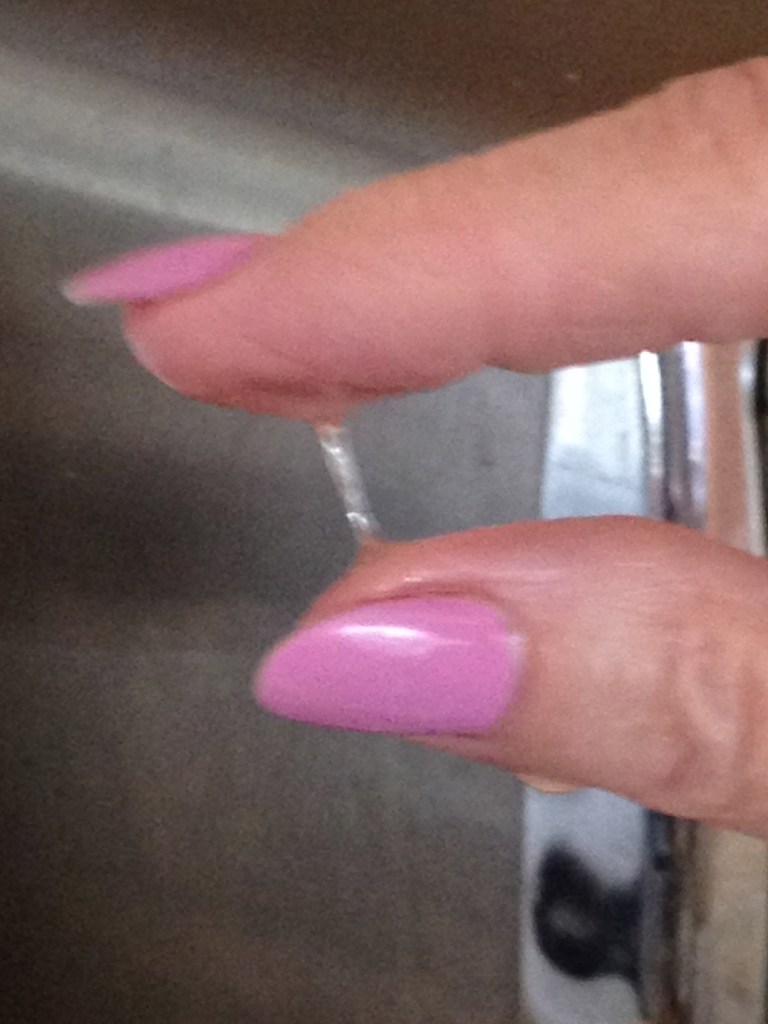
In the meantime, mix sugar and water and heat over medium/high flame. Make sure sugar dissolves. Bring to a boil. This is to make a sticky syrup. Stir and watch carefully so it does not discolor or burn. Test for correct stickiness by removing spoon from pot, allow it to cool a bit, placing a drop on your fingers and noting a ‘thread’ of sugar when pressing then pulling apart finger and thumb.
At this point, lower the heat and add ground almonds. Thoroughly blend and constantly stir mixture. Cook and stir masapan until it reaches a dough-like consistency. ( it will cleanly leave the sides and bottom of the pan). Remove from heat and allow to thoroughly cool
Once cooled, knead on your rolling surface to create a smooth dough. Pinch off small portions and roll into a long strip. (Perhaps cut into 10 – 12 portions before rolling).
Keep a bowl of water handy. Dampen your rolling surface and hands, as it will make it easier to roll out. Cut at an angle into diamond shaped pieces.
Our tradition has been to top with a decorative silver ball ( dragees ). These are for decoration and not to be consumed.
For engagements, our tradition has been to make a “mano” (hand) fashioned out of masapan, with silver dragees across the ring finger. This is fashioned on a tray, surrounded by cut pieces of masapan, jordan almonds and often, a gold leafed piece of ‘aruda’ ( the rue plant).
Like all our delicacies, masapan takes a bit of practice. And the results are divine! Enjoy for your special celebrations…and for a special Passover treat!
As we begin to prepare for Pesah, it’s time to pull out the favorite family recipes, those familiar dishes that bind generations together, remind us of our connectedness…..brings us back to the familiar. One of the staples of our seder meal is a megina, sometmes refered to as ‘mina,’ or a ‘meat quajado.’
My mom megina is made with crumbled matzah mixed in giving it a meat casserole- like consistency once cooked and able to be cut into and served in squares. The ‘mina’ version is often made with layers of soaked and softened matzahs and constructed more like a meat lasagna. I am sharing the recipe as my mom makes it for our family and as she has taught it in community cooking classes. This is one of those dishes you can customize to your liking, adding different spices for a differnt flair ( think cumin or ‘ras el hanut,’ diced peppers or even cilantro instead of parsley, to name a few). This version is made with ground beef, although ground turkey or ground chicken could be substituted. Let us know what you think!
My Mom’s (Kaye Israel) Recipe for Passover ‘Megina’ (meat casserole) {sometimes called Quajado de Carne or Mina}
As one of my friends points out, anytime you start with sautéed onions and meat……how can you go wrong?
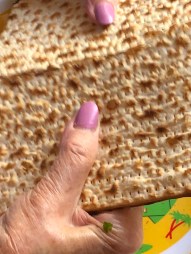
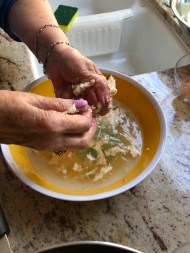
2 C chopped onions 2 lbs ground meat 2 tblsp oil 1/2 tsp pepper (to taste) 1 tblsp salt 1/4 c parsley, chopped 8 – 10 eggs 1 C farfel (soaked in warm water, and squeezed dry) or 4 sheets matzah (soaked in warm water, squeezed dry and crumbled) touch of red pepper flakes (optional)
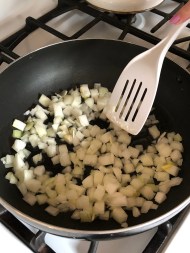
Brown onions in oil.
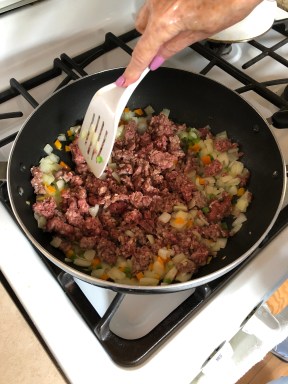
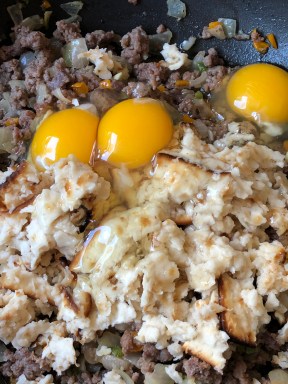
Add meat and continue to brown.
Transfer to bowl and allow to cool. Add salt, pepper, parsley and farfel (or matzah). Add 2 beaten eggs at a time until eggs are mixed in.
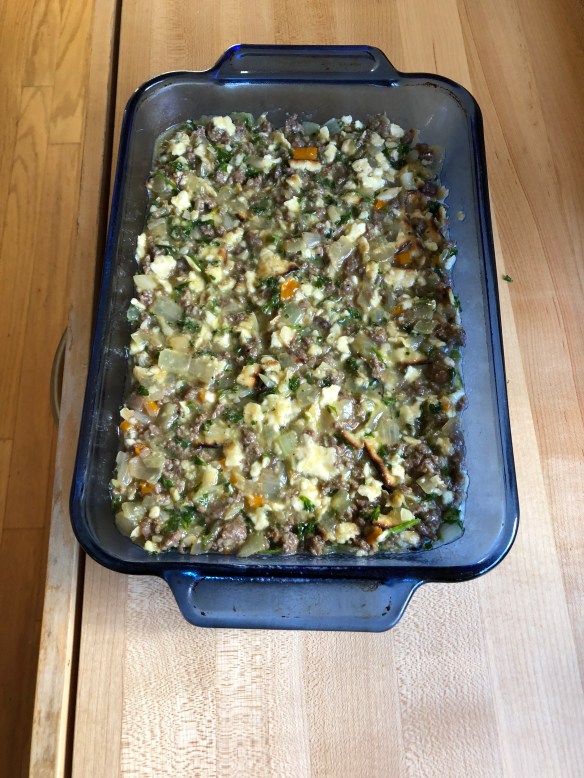
Grease 9 x 13 inch pan (pyrex type) and heat in oven for 2 – 3 minutes. Pour mixture into pan.
Bake at 400 degrees for 30 minutes or until golden brown. Allow to cool. Cut into squares and serve. Delish!!!!
We serve this as part of our holiday meal. It’s also a staple during the week. Easy to cut a square for lunch and serve with a light salad for lunch or easy dinner. Easy to transport for those who need to take a lunch to work or school. (I have one cousin who looks forward to megina each year with cranberry sauce on the side. I know, they didn’t have cranberries in Rhodes. That’s how we create new traditions!) Enjoy it! Make it your own!
A Sephardic Rosh Hashanah ceremony combines elements of Tashlich and a healing ritual.
With joy we share our family tradition of “Lavar la Cara” (washing our faces in the ocean). It seems that this tradition combines many elements of two ceremonies. The first is “Tashlich” from the Hebrew “to cast off,” referring to the custom of tossing bits of bread in the water to symbolize the casting off of our sins. The second is a healing ritual of the Rhodeslis — those who trace roots to the island of Rhodes, tossing ailments into the ocean and receiving renewed health from the ocean, HaShem and the incantations and blessings of our elders.
Over the generations, our family tradition had been to go to the beach on the first day of Rosh Hashanah. Now that we live in disparate parts of Los Angeles, have differing synagogue schedules and levels of observance, our extended families (about 40 of us) come from throughout the greater Los Angeles area and meet at Venice Beach on the Sunday morning between Rosh Hashanah and Yom Kippur, bringing our beach chairs and something to share at our informal brunch that follows.
Once set up, we go down to the water, usually in smaller family groups. A family matriarch, one by one, blesses us and washes our faces. Bending down to capture a handful of water from a new wave, she washes the face of each of us, saying in Ladino, “todo mal ki se vaiga” (“everything bad should go”). She elaborates: “Everything that is bothering you, worrying you, anything that is harming you, any sickness, illness, any fright or discomfort, all this, should be swept away to the very depths of the ocean.” She then bends down to scoop a fresh handful of water from a new wave. Washing our face and the back of our neck again, this time saying “todo bien ki se venga” (“everything good should come”). Again, she elaborates, “Everything now will be good, your pain will go away, any illness will leave your body, healing will come to you. Every worry is now gone. New ideas and good thoughts will fill your mind. Your heart will be content.”
To each, now, she gives a specialized blessings for the New Year. To children she might offer that they will do well in school, be happy, enjoy their friends, make their parents proud or have a good year in sports, theater, Hebrew school; whatever is appropriate to that child. To the young adults, she might offer that they will do well in school, find jobs or the right person to share their lives with. Newlyweds are blessed to find happiness together, build a home and life together, have children. After the individual blessings, the matriarch gives each of us a finger full of sugar, which she puts in our mouths for a “sweet” year. This is no regular sugar; the sugar is from the Rosh Hashanah table. After we use sugar for our Hamotzi prayer on this holiday, the remaining sugar goes into a baggie and comes with us to the beach.
There are variations. Sometimes we invoke the names of the Patriarchs, “Con el hombre del Dio di Avram, Izhak, Yaacov, Rey David i Shelomo,” as well as the Matriarchs, “Rivka, Sarah, Rachel, i Leah.”
On occasion we add a new tradition, like dancing along the shore. New traditions are always welcome!
Blessings complete, we return to our beach chairs, sit for a nice ‘vijita’ (visit) and enjoy coffee, juice, bagels, borekas (Sephardic cheese and rice or potato pastries), biscochos (tea cookies), spinach quashado (soufflé), assorted cheeses with olive oil (usually feta and ricotta), homemade breads (rosca), fruits and dessert pastries. We stay and visit, feeling renewed, and certainly feeling a great deal of love from and for our family. It’s a New Year. The Day of Atonement is coming soon. We are ready to face it with a humble heart, renewed spirit and a refreshed outlook.
“Masapan”……marzipan….that delicious sweet that our mothers lovingly make for engagements, weddings, a brit milan or a Bar (and today even a Bat) Mitzvah. Basically a homemade almond confection made with ground almonds and sugar, Marzipan traces it’s origin to …..well….that depends. Some say the Persian empire, introduced to Europe by the Turks; others claim the origin to be Spain. In any case, it got to us, was a delicacy on our beloved Island of Rhodes, and our grandmothers brought it here with them when they came to these shores.
While some in Eastern Europe talk of marzipan being colored and fashioned into miniature fruit-like shapes, our variation is kept in it’s white, pure state, made into a simple design – A very special variety is shaped into a ‘pastelico’ like cup and filled with rosewater or orange blossom scented ‘shroupe’, capped and artfully edged….a treat for the senses!
My mother, Kaye Hasson Israel, uses a recipe shared with her by Rebecca Levy. I watched her make it last week. Here is the recipe and photos. This recipe makes about 125 pieces of masapan.
6 C almonds
3 C sugar
4 C water
Start with raw almonds. To blanche, bring a pot of water to a boil. ( enough water to cover the almonds). When water boils, add almonds and leave them in for 4 to 5 minutes (until skin is loose).
Rinse in a colander with cold water. Remove the skins from the almonds and place almonds into a bowl of cold water ( to prevent discoloration).
Take a clean towel and dry almonds thoroughly.
Put almonds into food processor with blade.
Grind to a fine texture.
In the meantime, mix sugar and water and heat over medium/high flame. Make sure sugar dissolves. Bring to a boil. This is to make a sticky syrup. Stir and watch carefully so it does not discolor or burn. Test for correct stickiness by removing spoon from pot, allow it to cool a bit, placing a drop on your fingers and noting a ‘thread’ of sugar when pressing then pulling apart finger and thumb.
At this point, lower the heat and add ground almonds. Thoroughly blend and constantly stir mixture. Cook and stir masapan until it reaches a dough-like consistency. ( it will cleanly leave the sides and bottom of the pan). Remove from heat and allow to thoroughly cool
Once cooled, knead on your rolling surface to create a smooth dough. Pinch off small portions and roll into a long strip. (Perhaps cut into 10 – 12 portions before rolling).
Keep a bowl of water handy. Dampen your rolling surface and hands, as it will make it easier to roll out. Cut at an angle into diamond shaped pieces.
Our tradition has been to top with a decorative silver ball ( dragees ). These are for decoration and not to be consumed.
For engagements, our tradition has been to make a “mano” (hand) fashioned out of masapan, with silver dragees across the ring finger. This is fashioned on a tray, surrounded by cut pieces of masapan, jordan almonds and often, a gold leafed piece of ‘aruda’ ( the rue plant).
Like all our delicacies, masapan takes a bit of practice. And the results are divine! Enjoy for your special celebrations…and for a special Passover treat!
Hanukkah begins this coming Thursday evening. This is certainly a different year than what we’re used to. Here in Southern California we are going on lock-down again tonight – mandatory ‘stay at home’ orders, many more businesses closed, and we are being asked to not engage or interact with others who are not part of our own households. So much for holiday celebrations!!
As difficult as the social isolation has been and the tremendous strain on families unable to work, go to school and do so much of what we are used to doing, we are thankful for health, the incredible efforts of our medical personnel, emergency and city infrastructure employees who keep our cities functioning, the essential workers who make sure we can get what we need for ourselves and others, and friends, community leaders and clergy who have moved our communal life online and are doing what they can to keep us connected to one another.
It’s been a difficult year. Had anyone told us last year at this time that our entire way of life would be upended and the health of the entire world would be in peril…..we would have been incredulous. And now, after this tumultuous time, perhaps a vaccine is in sight. Perhaps there is a chance that we can leave our homes again soon and be together. Perhaps…..
This is, after all, the season of miracles.
Hanukkah celebrates the re-dedication of the Temple in Jerusalem after the Jewish victory over the Greeks in 165 BCE. The true miracle is that the Jews prevailed, the few against the many – and our Torah, our values and our essence of being as a people has survived, and BeH, will continue to not only survive but thrive, forever.
A favorite story is the Miracle of the Oil. The Jews went to reclaim and restore the Temple in Jerusalem after it had been defiled and left in ruins by the Greeks. There was only enough oil left to rekindle the candelabra for one day, though it was to burn throughout the night each and every night. It would be several days before more oil could be obtained. By virtue of a Miracle, the oil burned for 8 days and nights, until more oil became available.
To commemorate the Miracle, we prepare foods cooked in oil for the holiday of Hanukkah. Favorites are latkes (potato pancakes), sufganiyot (filled donuts), and in our family, burmuelos (fried dough).
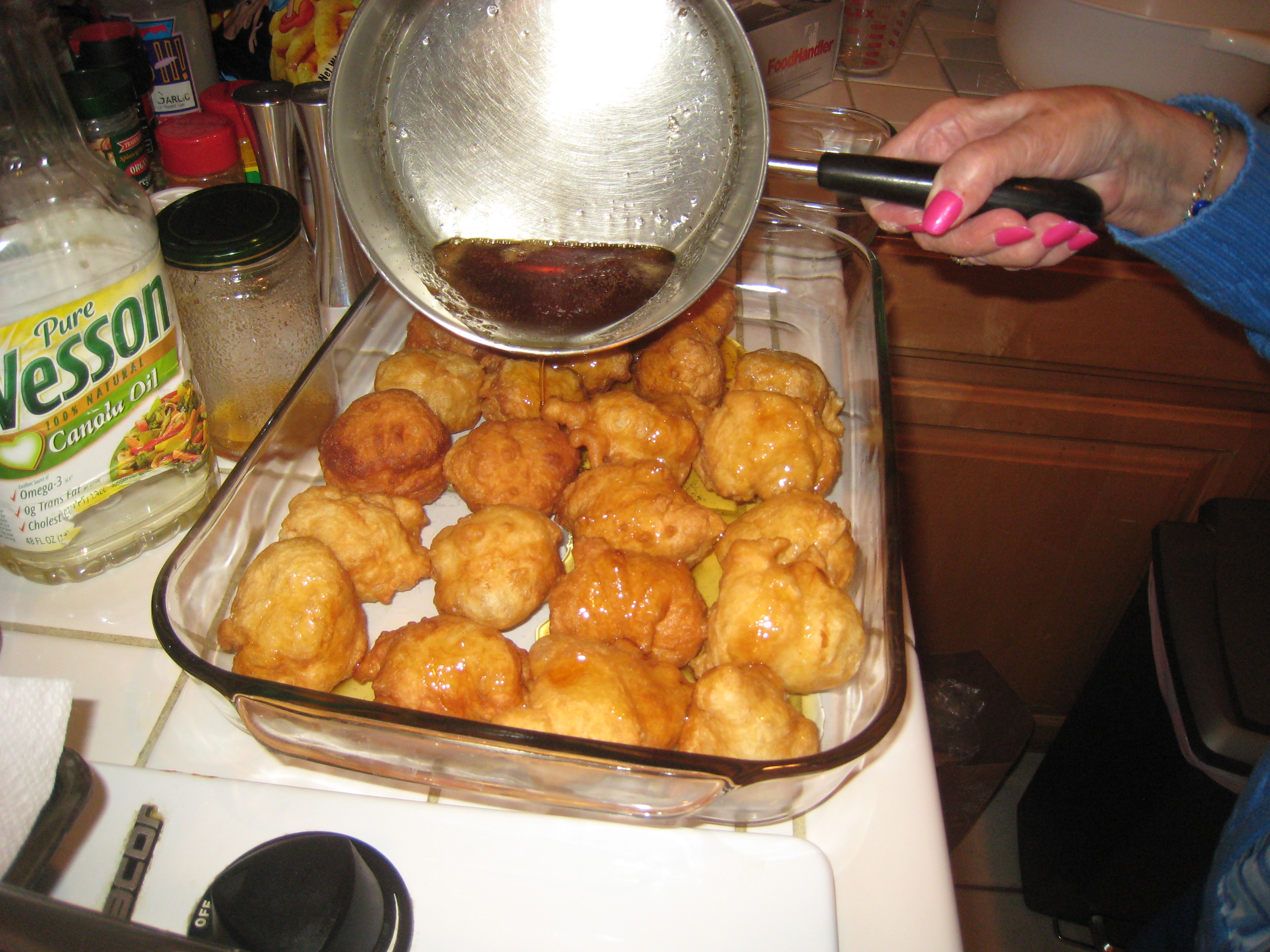
Growing up, I had never had latkes. Our Hannukah treat was always burmuelos – light, fried dough pillows bathed in a light, sweet syrup that is absolutely divine! (often compared to a New Orleans’ beignet, or a Greek loukoumades)
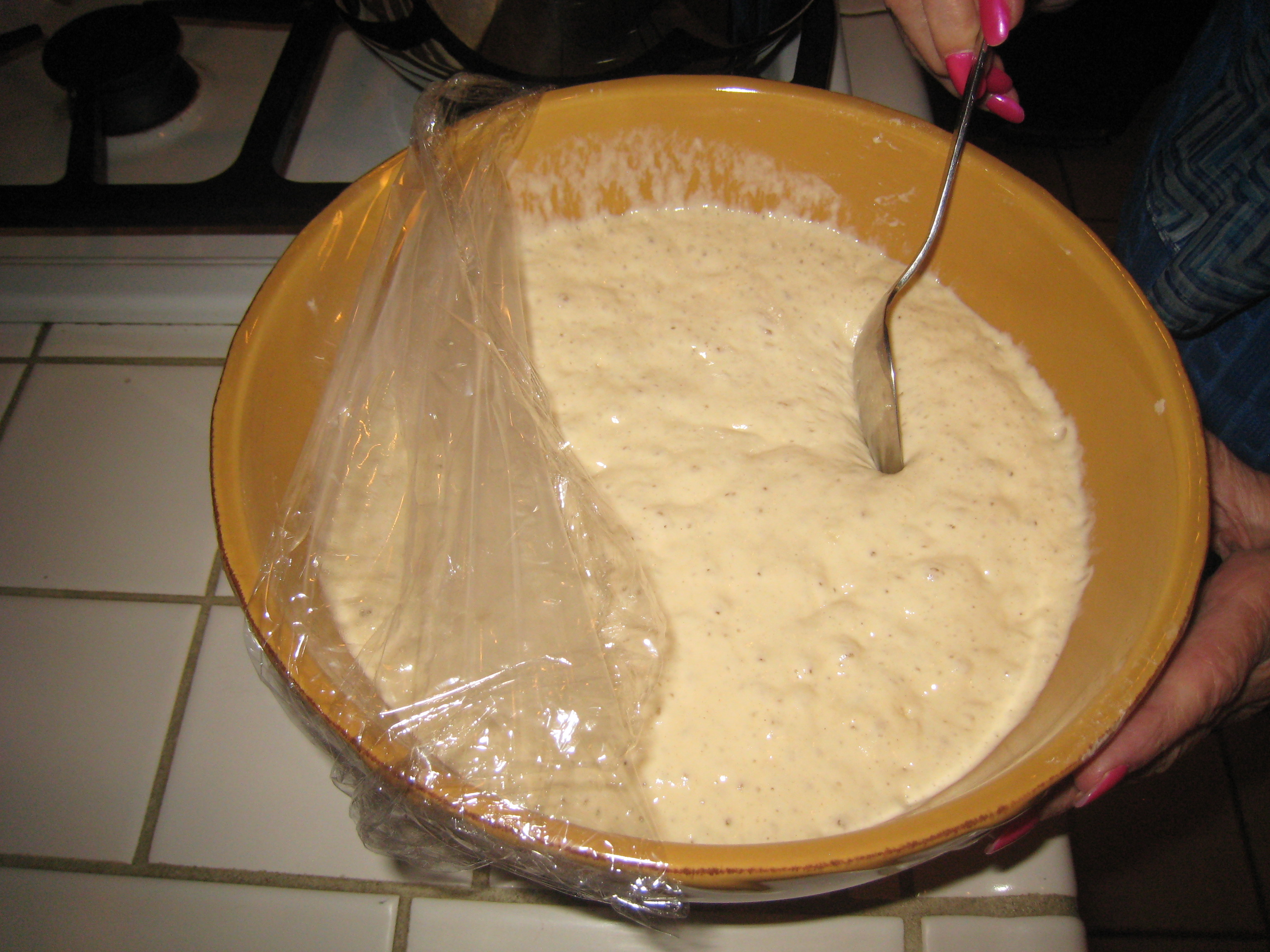
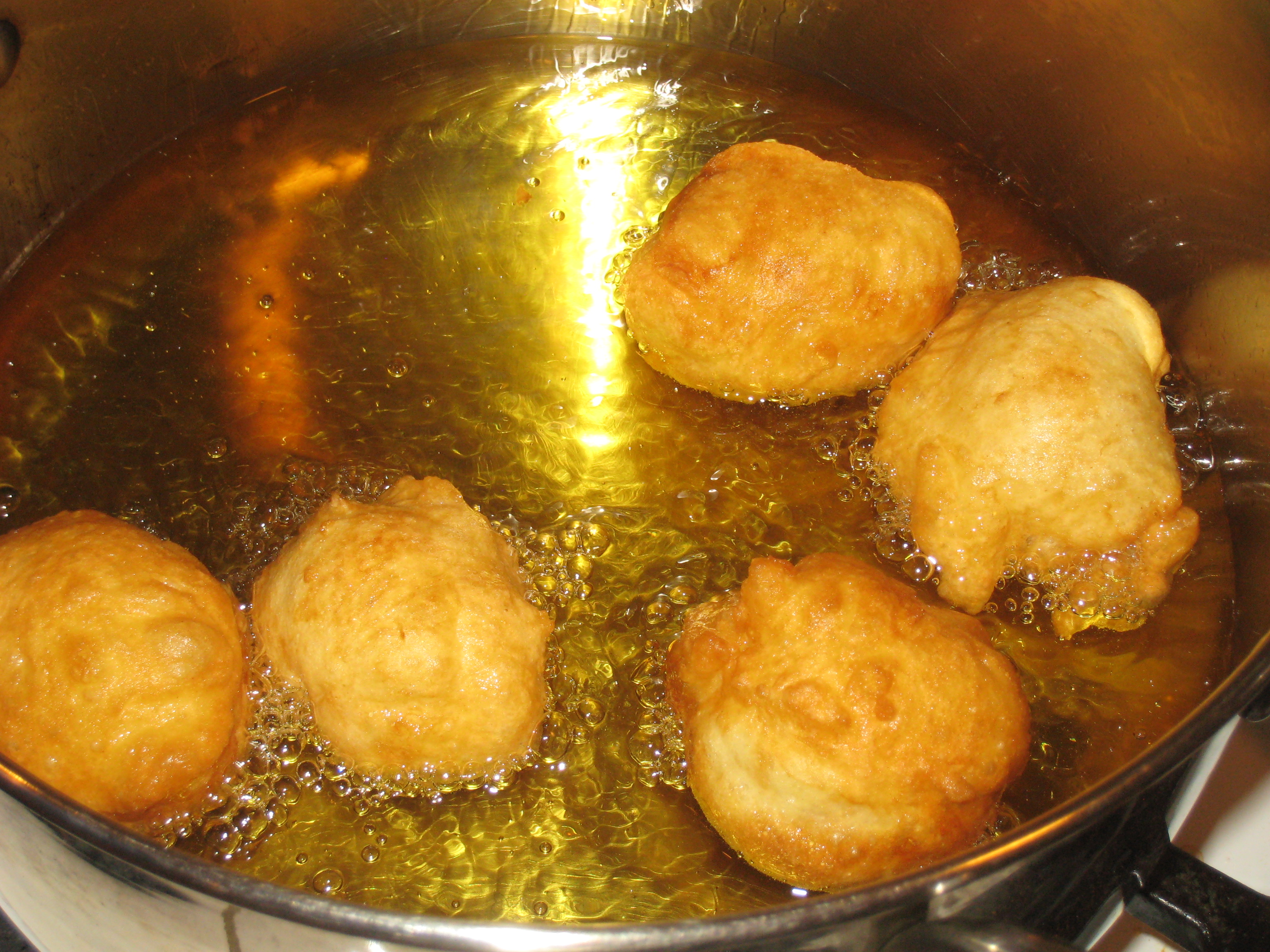
Made from a yeast dough, it takes some time for the dough to rise and be ready to fry. My mom will make the dough ahead of time and after dinner, drop the dough by spoonfuls into hot oil, watch them puff and turn a golden brown as she prepares the honey syrup. Once the burmuelos are ready, she will bathe them in syrup and we’ll eat them, warm and fresh! Divine, indeed!
Below is the recipe. Give them a try…..and enjoy!
My Mom uses the recipe from the cookbook, “Comé Con Gana,” compiled by the Sisterhood of Congregation Or Ve Shalom in Atlanta, GA.
1 tsp yeast 1/2 C and 1 1/2 C warm water pinch of salt 3 C flour 1 egg oil (for frying)
Soften yeast in 1/2 cup warm water. In mixing bowl add dry ingredients. Add yeast mixture, egg and remaining warm water. MIx well. Allow to rise in covered bowl in warm place for 2 hours.
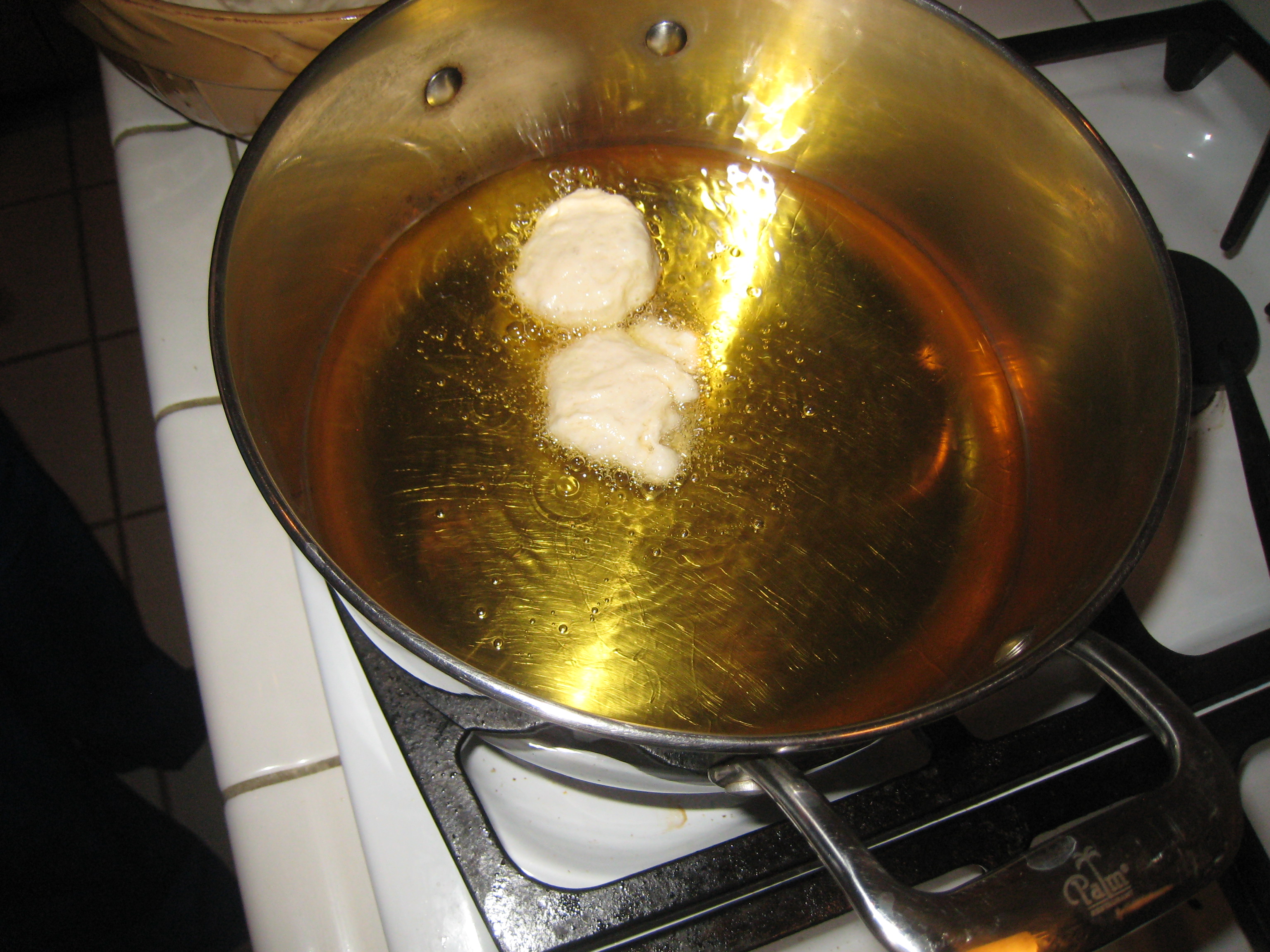
Fill a quart pot with 3 inches of cooking oil. Allow to get very hot.
Drop a teaspoon of soft dough into the hot oil. Then another…… continue.
Remove with slotted spoon when golden brown. Bathe in syrup.
Syrup
1 C sugar 3 Tblsps honey 1/2 C water
Boil together until sticky. Pour over burmuelos.
The Pandemic will end, BeH. Gam Zeh Ya’avor……This, too, shall pass. May we all be together with our families and friends soon, celebrating the many incredible moments of life. Let’s plan on it!!
The High Holy Days are right around the corner. Why is this year different from all other years? (sounds like words from another holiday!!)
This year, many of us are still staying ‘Safe at Home’ and will not be going to synagogue or gathering with our extended families. Not the holiday experience we are used to!
Our traditional Rosh Hashana Seder will take on new meaning. If you’ve never done this before, this might be a good year to give it a try. Share the idea with friends. A new year – new tradition – new meaning for our holiday.
One of the rich and unique traditions of our Sephardic families is a Rosh Hashana Seder. It is a short service we conduct around our tables with the Rosh Hashana evening meal, with some families doing it on both nights. Including the traditional blessings done at the holiday meal table (Kiddush, Blessing of the Children, Washing of the Hands, HaMotzi), blessings are also said over symbolic foods, expressing our hopes and wishes for the year ahead. Most of the foods used are those whose names in Hebrew sound similar to one of the wishes expressed, so there is some fun associated with this!
Although primarily a Sephardic tradition, many others have begun adding the Seder to their Rosh Hashana celebrations. My father remembers the “ratzones” from his childhood in Seattle…we began sharing the tradition with our children and friends within the past decades. Rabbi Yitz Greenberg suggests that each family add some blessings of our own, adding to our family traditions, adding puns we create around foods we include, which we have done from time to time. One of our Rebbetzins, Penina Schochet, suggested that we select a new fruit each year, having our young children be part of the process, and say a “shehecheyanu” over the addition of the new fruit, as a way to further grace our Rosh Hashanah table and include our children in selecting and trying something new.
Some families refer to this “service” as the “Yehi Ratzones”, referring to the words used “May it be Your will …” as referencing the symbolism that is to be recited. Often one hears the words “simanim”, referring to the ‘symbolic’ foods used. I will note some of the foods we eat and the translation of the blessings we say, primarily based on the materials prepared and provided by Sephardic Temple Tifereth Israel (STTI) in Westwood, California, as well as materials prepared by the Maimon Family in Seattle, Washington.
My good friend, Linda Sendowski, has some wonderful recipes for Rosh Hashana foods, specifically these symbolic foods on her blog The Boreka Diary which I share with you. Also, the Rosh Hashana table of the delightful Stella Hanan Cohen was recently featured in the South African Jewish Review(Pages 14-16.) Finally, one of my favorite cooks, Debby Segura, offer these ideas for the holiday meal. (my favorite is her Simanim Salad, incorporating most of the Seder elements in one dish). Check these out…and consider including some of these ideas and blessings at your Rosh Hashanah table this year.
For our Seder, we prepare a plate on the table that holds some of each symbolic food, and a prepared page for all our guests, including the blessings we will recite for the evening so all can participate. We include the Hebrew and English, and some years, the Ladino. Adapt as is comfortable for your household. We start with the Kiddush, the Shehecheyanu, Birkat Yeladim (Blessing of the Children), Washing the Hands, and the Hamotzi.
Following that, we recite a few blessings with intended good for the New Year, over some symbolic foods. The foods we use are usually plentiful during this season. Their Hebrew names, shades or colors remind us of our hopes and dreams for the year ahead. It is noted that “foods provide us an occasion to wish away our fears and verbalize our deepest hopes, as well as a chance to pun on their names in a number of local tongues”. (Source: Noam Zion in his paper Seder Rosh Hashanah)
1. Apples dipped in sugar or honey; apple cooked in sugar or honey; or candied apples:
Yehi Ratzon May it be your will, Lord our God and God of our Fathers, to renew upon us a good and sweet year, from the beginning of the year until the end of the year.
Baruch Ata Adonai Elohenu Melech Haolam Bore Peri Haetz.
2. Leeks (karti):
Yehi Ratzon May it be your will, Lord our God and God of our Fathers, that our enemies be cut off, as well as those who desire to do us harm.
(this is based on the wordplay between the Hebrew word for leek, “karti”, which is similar to the word “korat”, meaning “to cut off”)
3. Beets or Spinach (“silka” is usually identified as beets; Keter Shem Tov says it refers to spinach):
Yehi Ratzon May it be your will, Lord our God and God of our Fathers, that our enemies disappear, as well as those who desire to do us harm.
4. Dates:
Yehi Ratzon May it be your will, Lord our God and God of our Fathers, that our enemies be consumed as well as those who desire to harm us.
(this is based on the wordplay between the Hebrew for dates, “tamar”, which is similar to a word meaning to “end” or “consume”)
5. Pumpkin or gourd (zucchini or squash; “kalavasa” is often used) (my cousin Sarita makes Fila Triangles with a Pumpkin Filling):
Yehi Ratzon May it be your will, Lord our God and God of our Fathers, that you should tear up any evil decrees against us and let our merits be read before you.
(this is based in the wordplay between the Aramaic word for pumpkin or gourd, “kara”, and the Hebrew word meaning to “tear”)
6. Fish (pishkado) (a friend whose family doesn’t eat fish, uses the Kosher Jelly Fish Candies for this one):
Yehi Ratzon May it be your will, Lord our God and God of our Fathers, that our merits may multiply as the fish in the sea. Others have commented that as fish is a symbol of abundance and fertility, we ask God to Bless us with both.
7. “Ruviah”, often identified as Fenugreek, although sometimes referred to as black eyed peas or string beans. It is told that in Bagdad, it was referred to as “luviah”. Since it was similar to the Hebrew word “lev”, meaning heart, the word “ut-labevenu” (meaning “and purify us”) was added. (Linda Sendowski has a great recipe for Black Eyed Peas!)
Yehi Ratzon May it be your will, Lord our God and God of our Fathers, that our merits increase and that you purify us.
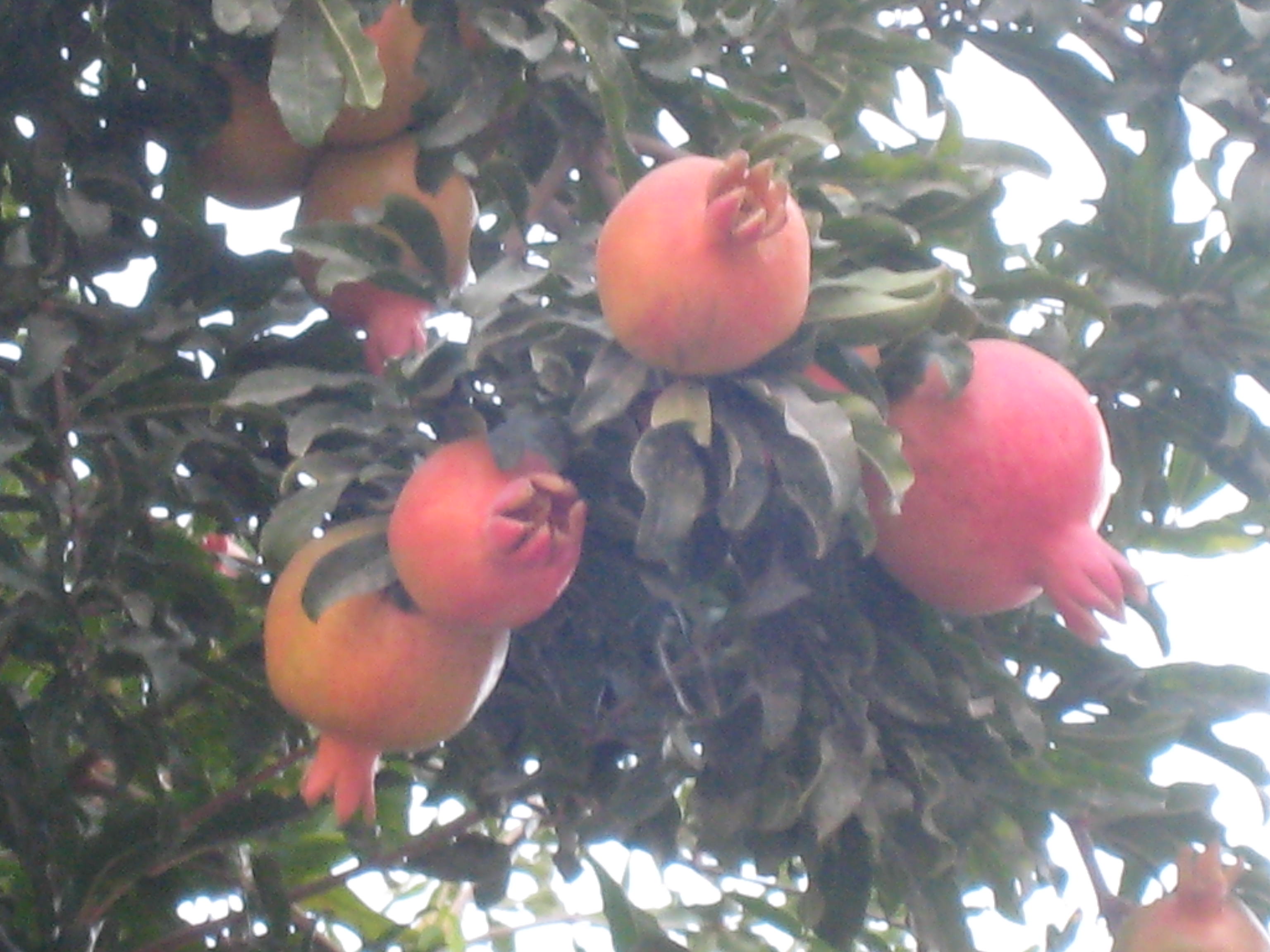
8. Pomegranates (Use the seeds in your cooking or in a salad)
Yehi Ratzon May it be your will, Lord our God and God of our Fathers, that our merits increase as the seeds of the pomegranate.
9. Head of Fish (something from the head….in our family, my Aunt Belina Hasson used to make tongue (I cannot get myself to even buy a tongue, let alone figure out how to cook it….so, since this is based on puns, we use a “head” of lettuce, some use a “head’ of garlic):
Yehi Ratzon May it be your will, Lord our God and God of our Fathers, that we may be in the forefront as the head, and not the background, as the tail.
The festival meal then follows.
In keeping with Yitz Greenberg’s suggestions, one could add: Peaches: May it be a “peachy” year Dates: May our single friends have many “dates” this year Mushrooms: May our abundance “mushroom” in the years ahead….
Have fun with this and make it meaningful to your family. Finally, I am attaching a link to a YouTube series of “The Selichot of Ezra Bessaroth”, in Seattle, Washington. It is a ten-part series of the Selichot service in the tradition of the Jews of Rhodes, led by Hazzan Isaac Azose, with many in the Congregation participating. The melodies are familiar to those of us who grew up in Rhodesli Sephardic Synagogues. There is something comforting and reaffirming in melodies, memories and flavors of our youth. I hope you will take a few minutes to listen and enjoy.
Please share with us any of your own family traditions….we would love to post them. Sharing keeps traditions alive and evolving for each new generation!
From our home to yours, Anyada buena i dulse ke tengas….a good and sweet New Year to all; Tizku Leshanim Rabot…May we all merit many years;!
Biscochos are often called tea biscuits. We think of them as a “biscotti”, a crunchy treat! Biscochos are a bit sweet and are wonderful with your morning coffee (could be afternoon or evening coffee or tea or even milk, for that matter!!) If you’ve been to my mom’s home or to mine (or to our synagogue)you’ve had one of my mom’s Biscochos!
Ingredients for My Mom’s Biscochos
1 C eggs
1 C sugar
3/4 C oil
3 tsp baking powder
1 tsp vanilla flavoring
4 – 7 C flour (according to feel of dough;looking for a soft, not sticky dough)
Topping:
1 egg + 1 drop of water, beaten well
sesame seeds
(alternative to sesame seeds: cinnamon and sugar or “sprinkles”)
These are my mom’s directions:
With electric mixer, beat eggs and oil in a mixing bowl. Add sugar and vanilla and continue to beat until well blended. Add flour and baking powder gradually (start with 3 C into the mixer….). Remove from Bowl when it begins to pull away from sides of bowl. Continue to add additional flour if necessary and knead into a medium dough until no longer sticky.
Place onto floured work area and finish kneading dough with additional flour as needed. Dough should not be sticky as long as you can handle it without it sticking to your hands.
Take walnut-sized pieces and roll down on table with palms of hands into a rope 5 inches long and only 1/2 inch thick.
Press down with fingers to create channel;
Fold rope over and cut slits into the edge.
Join into a bracelet shape. Brush egg on top side.
Dip top side into chosen topping ( sesame, cinnamon sugar or sprinkles):
Place on cookie sheet lined with parchment paper. Bake in preheated 350 degree oven for 12 minutes or until lightly brown. Remove from pan.
Stack vertically on baking sheet and return to oven at 200 degree for one hour to ‘biscochar.’ (Make crispy) Set your timer and remove from oven after an hour.
Reshas or Reshikas as they are sometimes called, are a favorite in our family. A resha is not actually sweet or savory; it is light and has a crunch that is sensational, especially if you love texture in your food! With a piece of abedahu, a few olives, some raki……our Happy Hour.
Reshas with a cup of coffee or tea and with a chunk of sharp cheese, a delight! My husband and my sons love them with dips such as tarama (a Sephardic caviar spread), with tzatziki (a Greek yogurt dip), and with ajada (a potato and garlic dip). Mostly, they love knowing they are in the kitchen, and grab one when passing through!!!!
Reshas take time to make.
So….how does one make these divine reshas? Start by making a yeast dough.
Kaye’s Resha Recipe
2 packets of Yeast Powder or 4 heaping tblsp of dry yeast
1 1/2 C + 1 tsp sugar
2 C lukewarm water
1 C oil
6 – 8 C flour
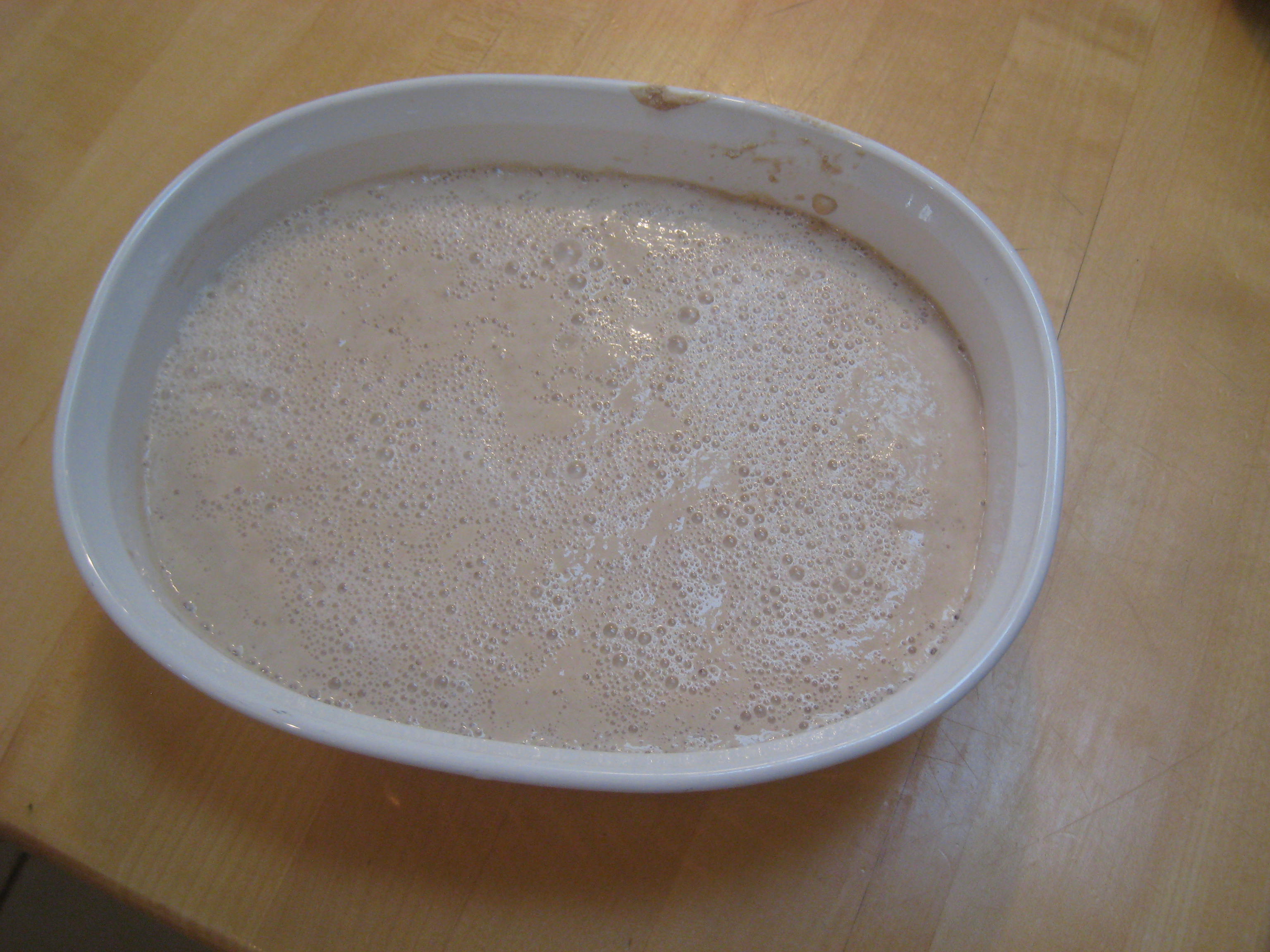
Start with 2 packets of fresh yeast ( always check expiration date on package). Place in a glass bowl. (*rinse bowl in warm water first). Add 1/2 C of lukewarm water. Add 1 tsp of sugar. Set aside in a warm place ( a toaster oven or microwave….not turned on). Allow yeast to proof ( foam), about 20 minutes.
Meanwhile, sift flour into a mixing bowl. (How much flour? you ask.) Start with 1 – 2 C to get mixing started. Add 1 ½ C of lukewarm water, oil, and 1 1/2 C of sugar. You’ll note that we have said “lukewarm” water several times. This means…..not cold from the tap, and not hot. Hot water will kill the yeast, and not only will your dough not rise, it will become heavy and brick like. Trust me….I’ve figured in the past that if warm is good, hot is better. Was I wrong! I ended up with a batch of doorstops, paperweights and hockey pucks!!!! SO…warm means….just that, warm!!!! (Now, go forth and figure out for yourself what that means!!!)
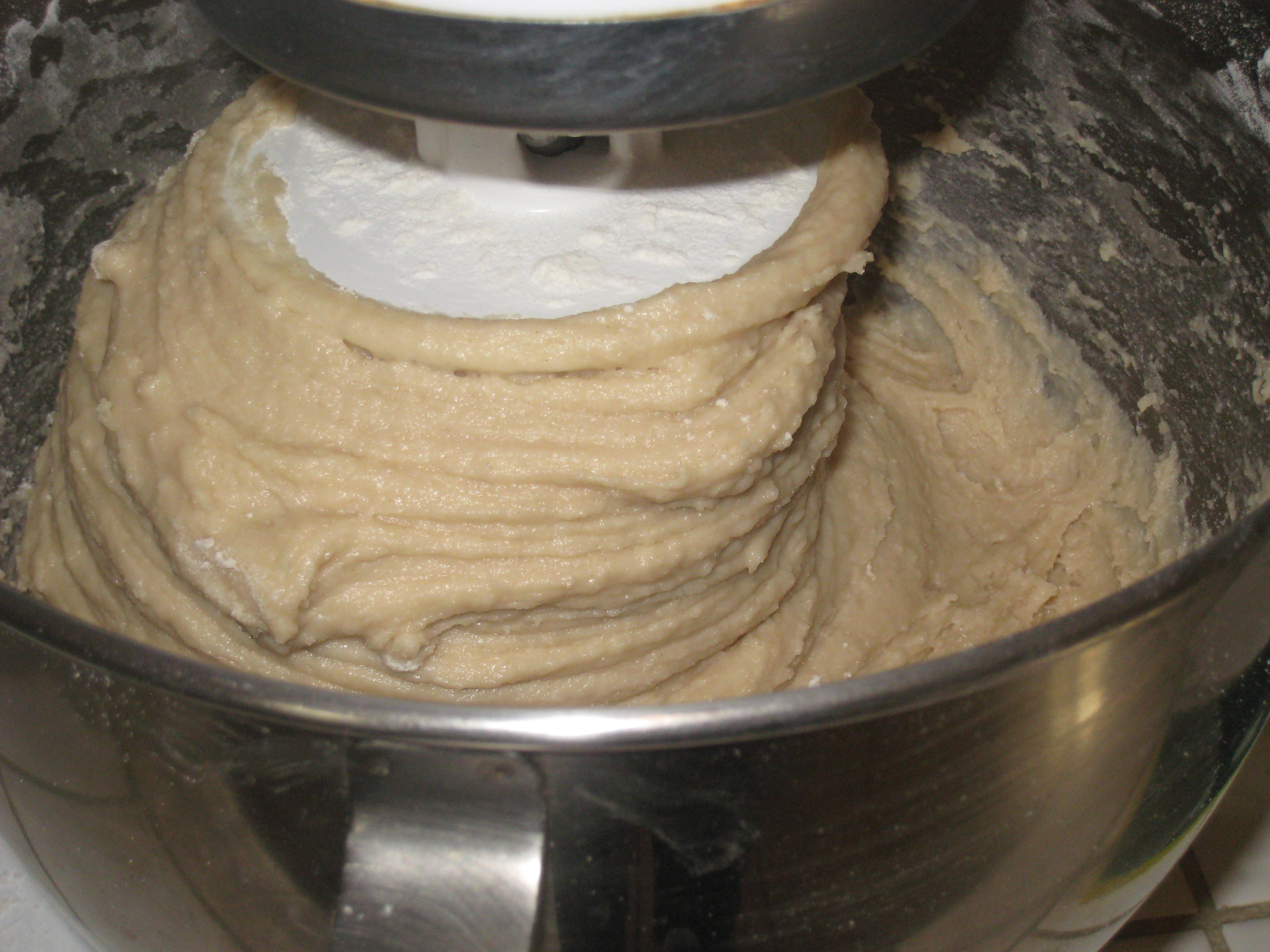
My mom use an electric Mix Master with a dough hook.
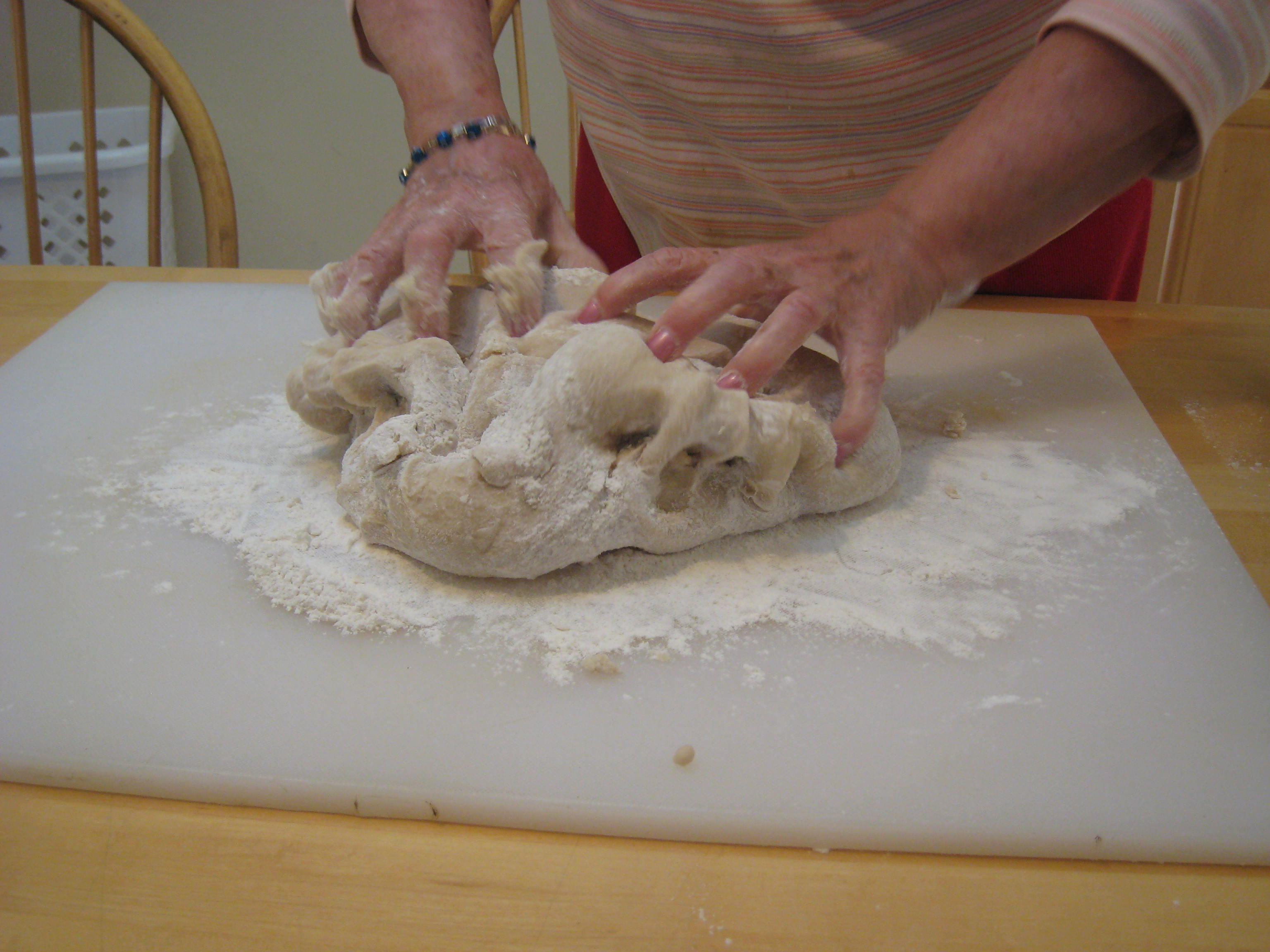
As you start mixing, add the foaming yeast mixture. Then, add additional sifted flour, approximately 1/2 cup at a time…..ultimately about 7 Cups. (Add it slowly….it will “suddenly” start to come away from the sides of the bowl and become “dough”). When it begins to come away from the sides, turn the dough onto a floured wood surface or table, adding approximately 1/2 cup additional flour. Work the dough; knead it. You want the dough not to be sticky as long as you can handle it without it sticking to your hands. To achieve this feel with the least amount of flour produces the best results. (You’ll get the feel of it, honest!)
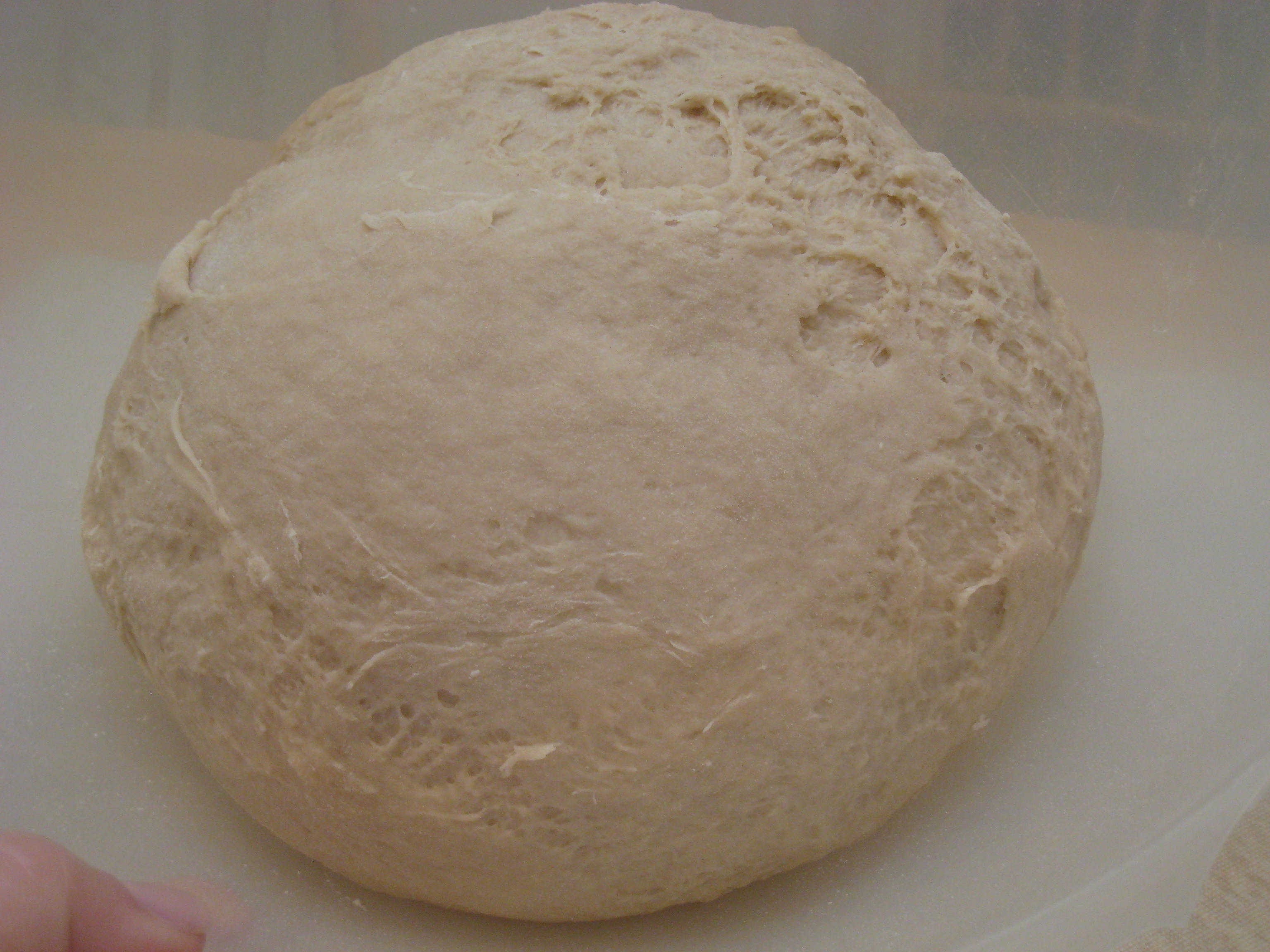
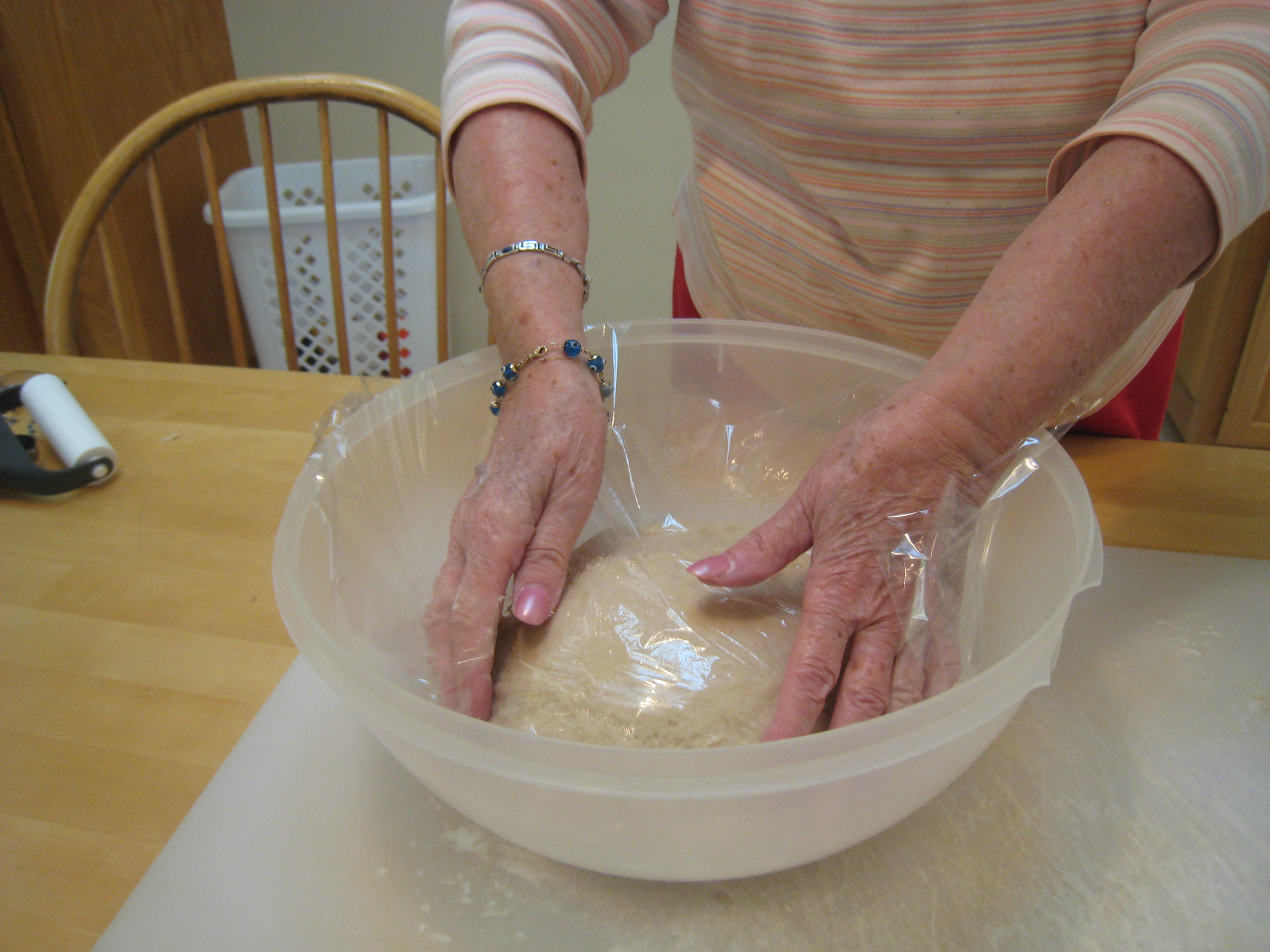
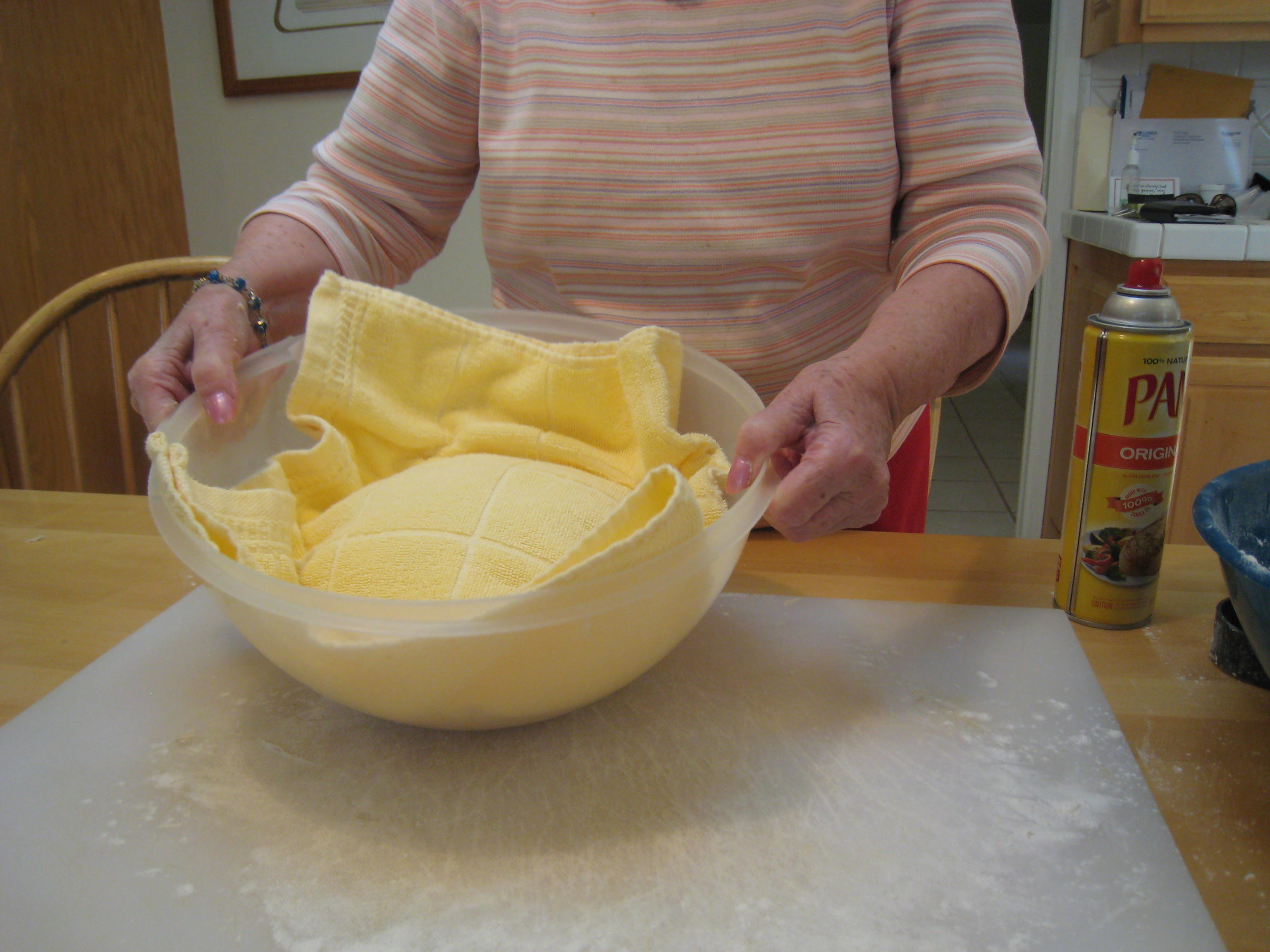
Put it in a bowl, cover with a piece of Pam-sprayed plastic wrap. Tuck the plastic edges in nice and cozy! Put the dough in a “warm” (i.e. draft-free) place and let it rise for about an hour. My mom will tell you this is a good time to go make the beds, or straighten up the house. My cousin will tell us it’s a good time to run up to Neiman’s and see what’s new. I’ll tell you it’s a great opportunity to start preparing some biscocho dough and make a day of baking!!!! You choose!
After it rises for an hour, punch it down…
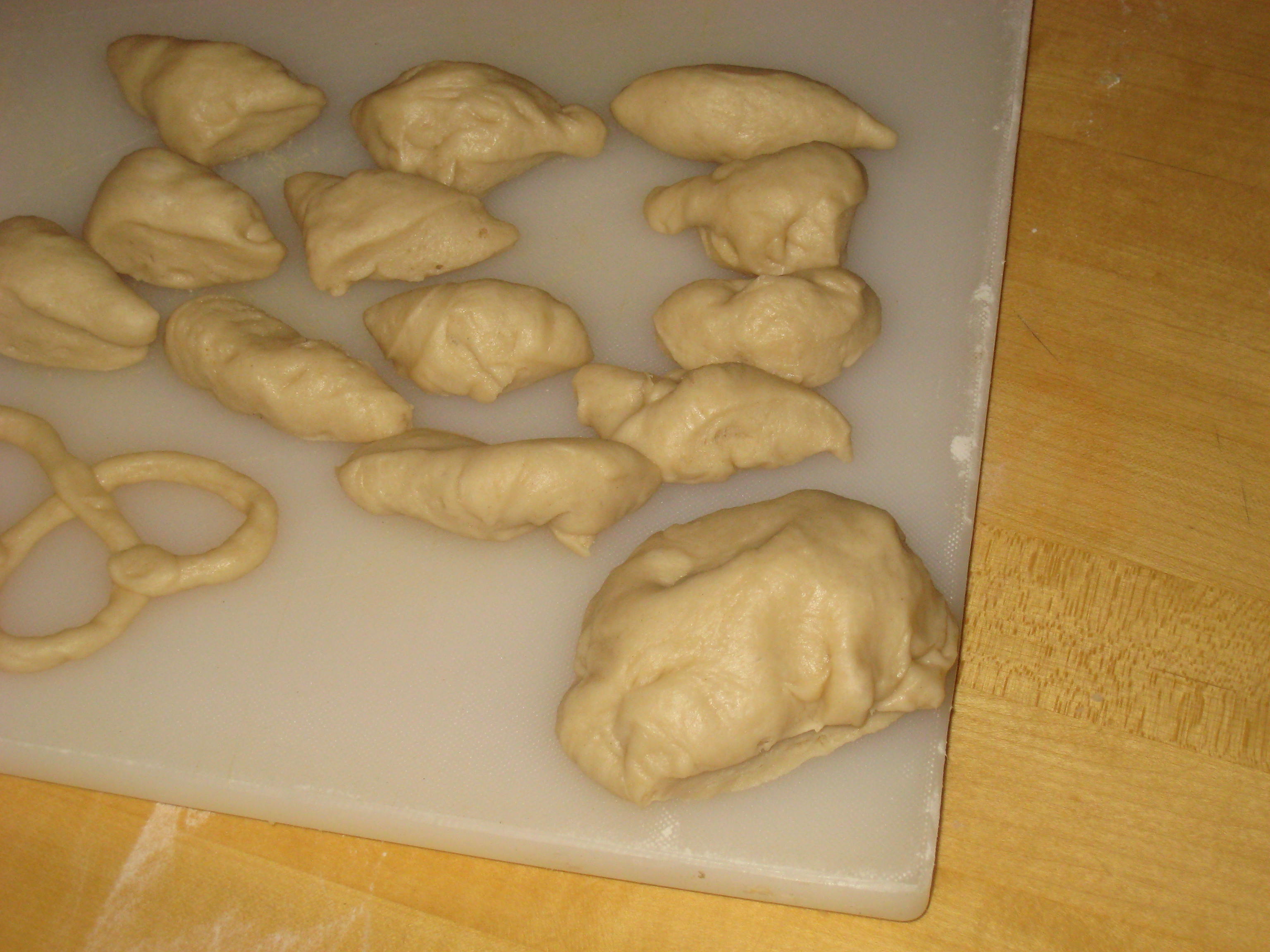
Cut the dough into walnut sized pieces.
Roll each piece into a long rope, perhaps 12″ long:
Turn into a pretzel-like shape. “Paint” with an egg-wash and dip into sesame seed. Place onto parchment lined cookie sheet.
Now, let them rest for another hour under cover as they rise again. Place in a preheated 350 degree oven. Here’s the important part: place baking sheet on low oven rack for about 10 minutes or until bottom of reshas begin to turn a golden color. Then place them on the upper rack of the oven. It should take about another 10 – 15 minutes until the tops become a golden brown as well. (This depends on the oven and might take a try or two to figure out the exact timing).
Remove from oven and allow to cool. Return them to a 200 degree for 1 hour to “biscochar” ( crisp ’em up). Enjoy!!!
Now you’re ready. Get your raki…..slice the abedahu. A few greek olives…..turn on Port Said……a few reshas. It’s time for Happy Hour! Enjoy!
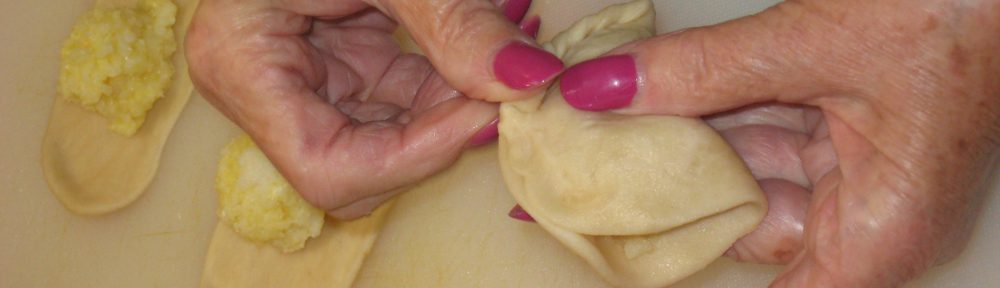
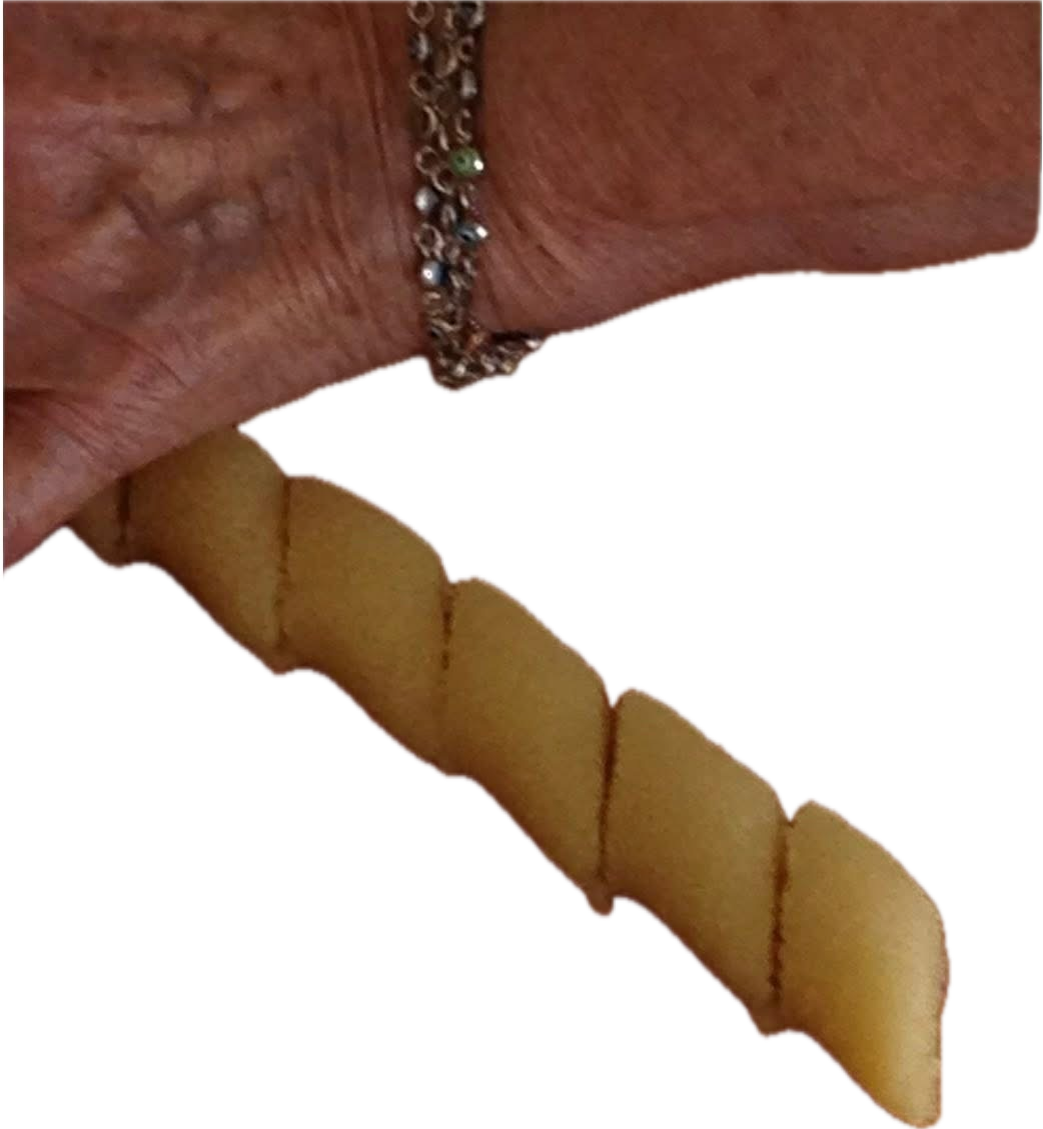
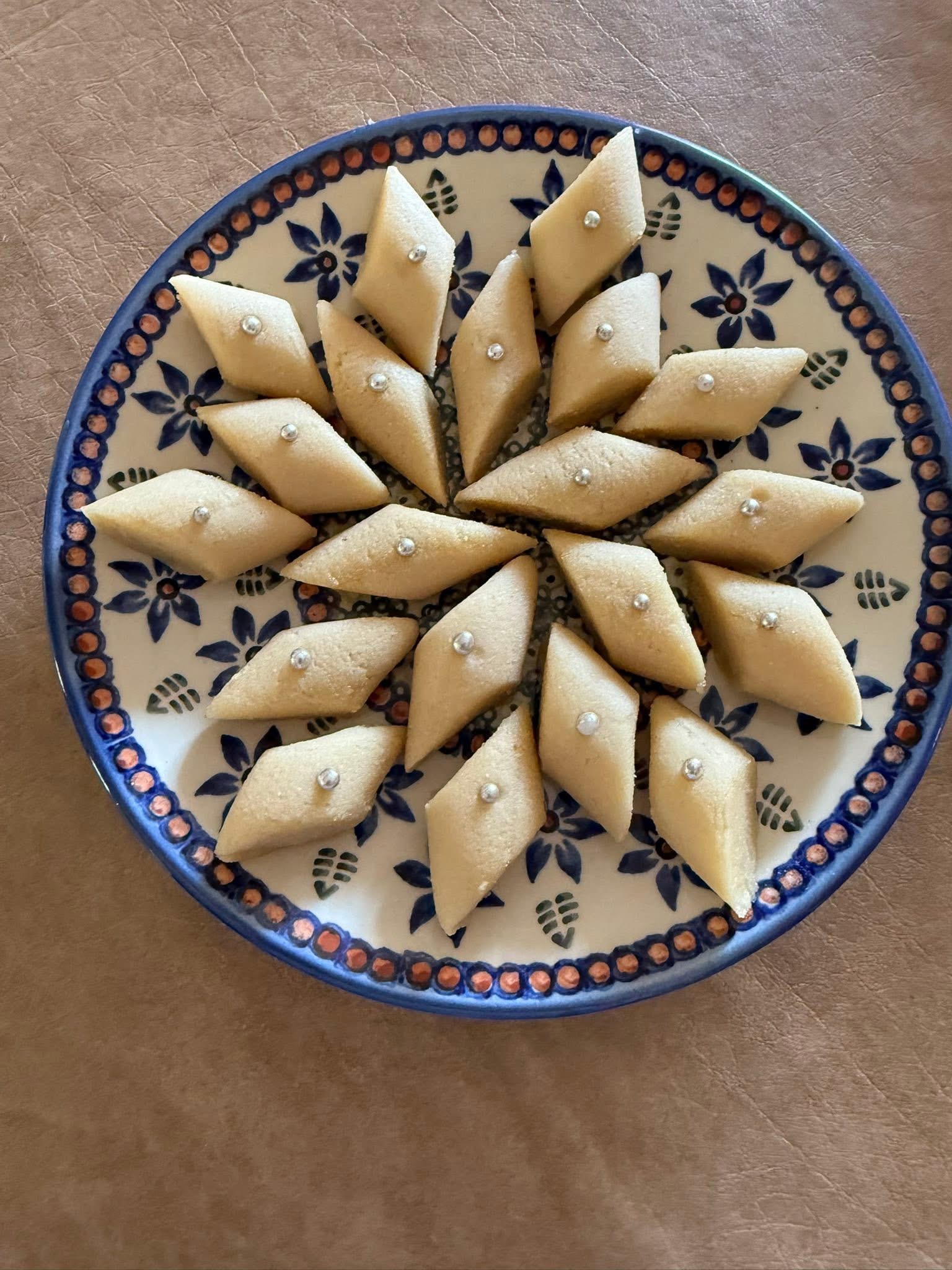

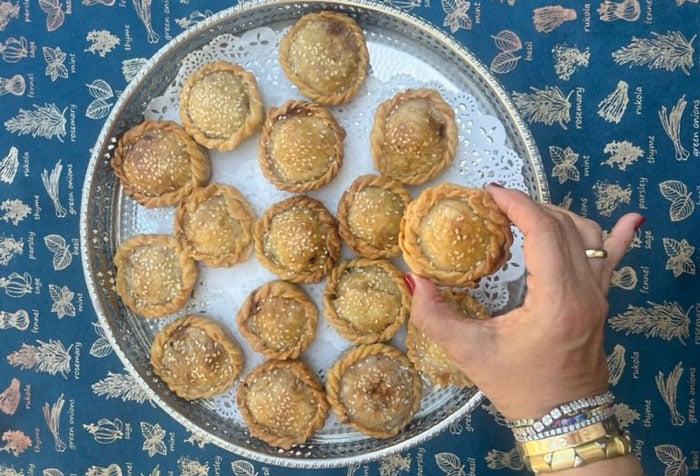 Photo by Shevy Gomperts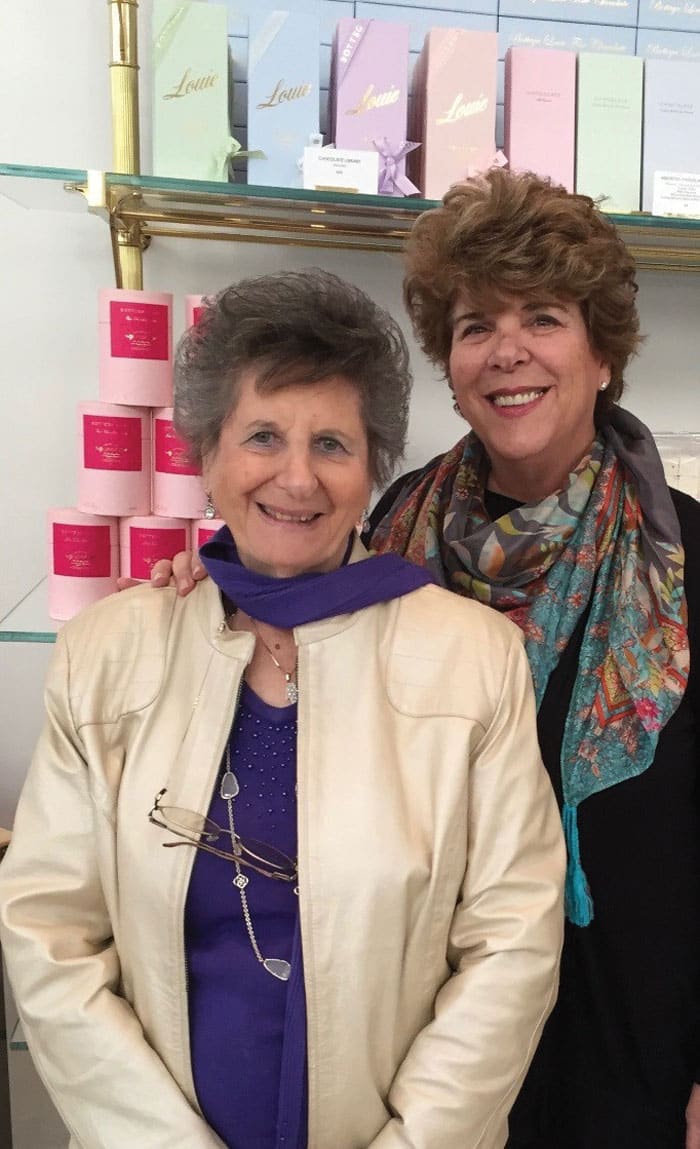















 BendichasManos.com